

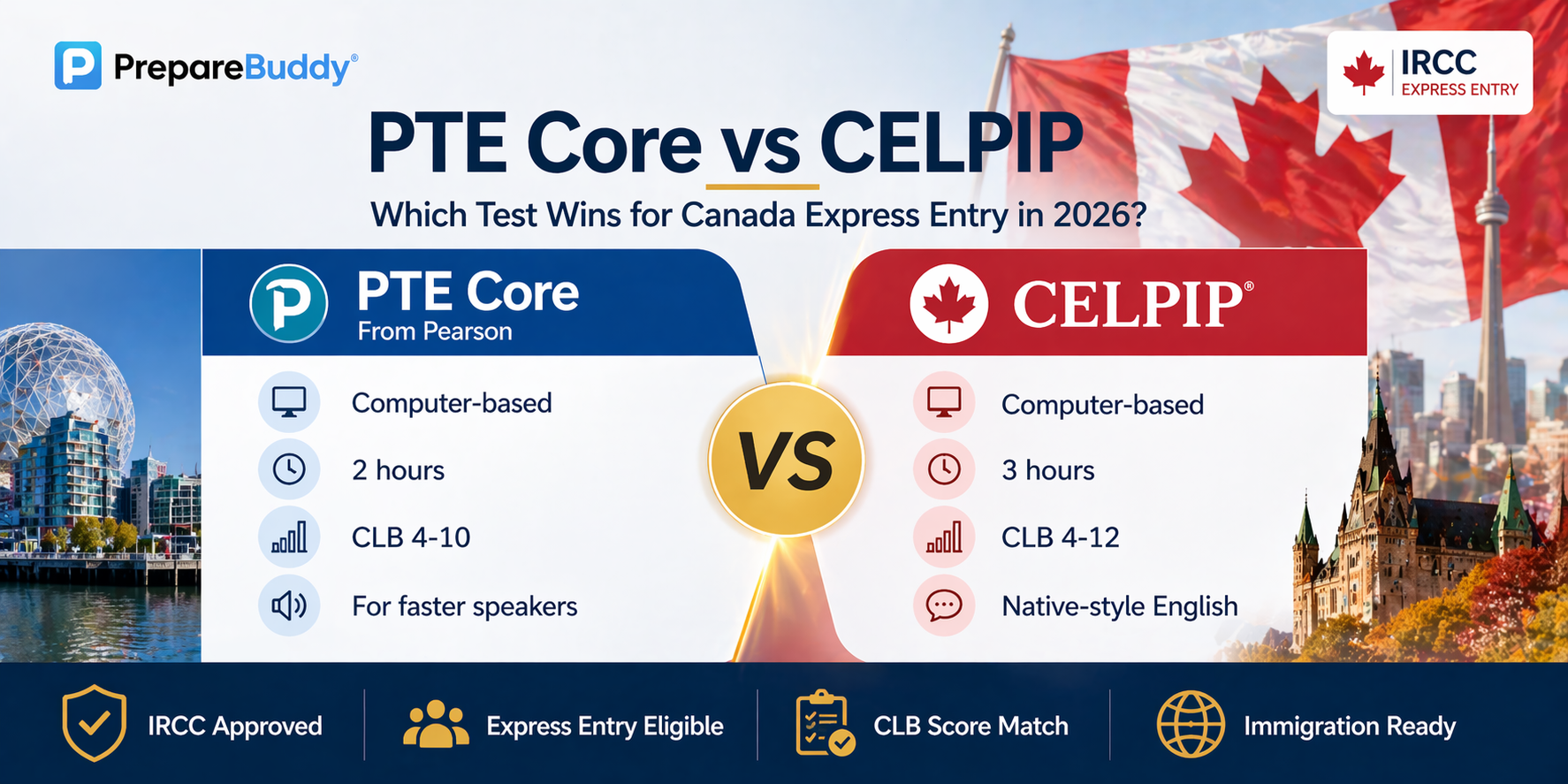
Two tests. One immigration goal. If your Express Entry application is landing in 2026, the choice between PTE Core and CELPIP-General is not cosmetic — a single CLB band can shift your CRS score by 25+ points and decide whether you clear the cutoff. Both tests are IRCC-approved, both score against the Canadian Language Benchmark (CLB) scale, and both can be booked inside a week in most Canadian cities. The real differences show up in format, speaking style, turnaround time, and — critically — how easy it is to hit CLB 9 on each one.
This guide breaks down both tests side by side using the latest 2025-2026 format data, then shows you exactly which one to pick based on your profile, your score target, and how you practice.
PTE Core vs CELPIP at a Glance
Both tests are computer-delivered, both cover all four skills, and both are accepted by IRCC for economic immigration programs including Express Entry (FSW, CEC, FST) and Provincial Nominee Programs. Here is how they line up on the basics.
| Feature | PTE Core | CELPIP-General |
|---|---|---|
| Purpose | Canadian PR, citizenship, professional designations | Canadian PR, citizenship, professional designations |
| Total duration | ~2 hours | ~3 hours |
| Scoring scale | 10-90 (mapped to CLB) | CLB 1-12 (direct) |
| Speaking format | AI-evaluated, recorded responses | 8 recorded speaking tasks |
| Writing format | Email + short essay | Email + survey response |
| Results turnaround | Typically within 48 hours | Typically within 3-4 business days |
| Test-centre availability | Pearson VUE centres worldwide | CELPIP centres (Canada-heavy, growing globally) |
| Retake policy | Next day (if seats available) | Flexible retake — no waiting period |
| English variety | Global/international English | Canadian English (accents, spelling, context) |
CLB Mapping: What Score Do You Actually Need?
Express Entry awards CRS points based on CLB bands for each of the four skills. Most successful PR candidates aim for CLB 9 (or higher for FSW bonuses). Here is how the raw scores translate.
| CLB Level | PTE Core (per skill) | CELPIP (per skill) | Why It Matters |
|---|---|---|---|
| CLB 10 | 78-90 | 10-12 | Max CRS points for language |
| CLB 9 | 60-77 | 9 | Most competitive Express Entry profiles target this band |
| CLB 8 | 51-59 | 8 | Minimum for CEC (NOC TEER 0/1 jobs) |
| CLB 7 | 42-50 | 7 | Minimum for FSW; most PNP streams |
| CLB 6 | 32-41 | 6 | Some PNPs, caregiver streams |
| CLB 5 | 24-31 | 5 | FST, some trades PNPs |
The practical takeaway: if you are targeting CLB 9 in all four skills (the sweet spot for most Express Entry draws), you need 60+ on PTE Core or a clean CLB 9 on CELPIP. Missing CLB 9 by one band on any skill drops you to CLB 8, which cuts your language CRS points roughly in half.
Section-by-Section: Where Each Test Feels Easier
Speaking
This is where most test-takers feel the biggest difference. PTE Core uses AI scoring on recorded responses — Read Aloud, Describe Image, Retell Lecture, Answer Short Question. No examiner, no conversation, no improvisation pressure. If you freeze in front of people, PTE's machine-scored speaking can feel fairer.
CELPIP gives you 8 speaking tasks covering advice, personal experience, predicting, comparing, making difficult choices, unusual situations, and recommending options. The tasks feel more "real-world Canadian" — you are asked to give advice to a friend or explain a problem to a neighbour. Preparation time per task is short (often 30-60 seconds), response time is tight (60-90 seconds). Natural conversational fluency wins here.
Rule of thumb: if you have strong pronunciation and consistent pacing but struggle with spontaneous topics, PTE Core is kinder. If you are comfortable speaking off-the-cuff about everyday Canadian situations, CELPIP plays to your strength.
Listening
PTE Core uses international English accents — British, American, Australian, Indian. CELPIP uses predominantly Canadian and North American accents with Canadian idioms and workplace contexts. If you have consumed Canadian media (CBC, Canadian podcasts), CELPIP audio will sound familiar. If you have trained on global English, PTE may feel less jarring.
Reading
Both tests emphasise functional reading — instructions, workplace memos, short articles. PTE Core's reading section includes integrated skills (e.g., fill-in-the-blanks that test vocabulary + grammar + context). CELPIP reading is more linear: read passage, answer multiple-choice questions. Test-takers who score well on IELTS Reading typically transfer smoothly to CELPIP Reading.
Writing
Both tests ask you to write an email. The second writing task is where they diverge: PTE Core asks for a short essay on a discussion prompt; CELPIP asks you to respond to a survey with your opinion and reasoning. CELPIP's survey format is shorter and more opinion-driven, which some test-takers find easier to structure in the time available.
Which Test Should You Choose?
| Your Situation | Recommended Test | Why |
|---|---|---|
| You freeze in front of examiners; prefer machine scoring | PTE Core | Fully AI-evaluated speaking, no human interviewer |
| You speak Canadian English well; comfortable with improv | CELPIP | Canadian accent familiarity + real-world prompts |
| You need your score in 48 hours | PTE Core | Faster results turnaround in most cases |
| You live in Canada and have access to CELPIP centres | CELPIP | Easier scheduling and retakes within Canada |
| You are applying from outside Canada | PTE Core | Pearson VUE has wider global test-centre coverage |
| You have already studied for IELTS | Either — IELTS skills transfer to both | Core reading and listening skills overlap heavily |
| You are targeting CLB 10 in speaking | CELPIP | Natural speaking rewarded; PTE Core's AI can penalise unusual phrasing at the top band |
How to Prepare Efficiently for Either Test
Whichever test you pick, the preparation pattern that wins is the same: take a diagnostic, identify your weakest skill, drill that skill with authentic practice material, and re-test every 10-14 days to track improvement.
PrepareBuddy supports both tests on one platform with unlimited AI-generated practice content matching the 2025-2026 official formats. Our 120B-parameter AI content engine produces tests that are 96% indistinguishable from real exam material in blind testing — meaning the practice you do on our platform behaves like the real thing.
Specific prep advantages that matter for PTE Core and CELPIP:
- Voice AI speaking evaluation — 48-emotion detection, 30+ English accent coverage, and real-time pronunciation scoring catch the exact patterns both tests grade on. See how Voice AI works at /features/voice-ai/.
- AI writing analysis with task-specific rubrics for email writing, essay structure, and survey-response formats. Our scoring aligns with 94% of human-grader decisions on writing samples.
- Adaptive difficulty — the platform adjusts question difficulty per skill, so you spend time on the weaknesses that actually hold back your CLB band.
- Unlimited mock tests — instead of the handful of official practice tests available through test providers, you get fresh authentic content every time you sit down to practice.
Frequently Asked Questions
Is PTE Core easier than CELPIP for CLB 9?
There is no universally easier test. PTE Core tends to favour test-takers with strong pronunciation and test-taking stamina; CELPIP favours those fluent in natural, conversational Canadian English. The smart move is to take a free diagnostic for both and see which one gets you closer to CLB 9 on your weakest skill.
Can I use PTE Core for Canadian citizenship?
Yes. IRCC accepts both PTE Core and CELPIP-General for citizenship applications at CLB 4 level. Both are also accepted for professional designations in many Canadian provinces.
Which test has faster results?
PTE Core typically releases results within 48 hours. CELPIP results generally land within 3-4 business days. If your ITA clock is ticking, PTE Core's turnaround can buy you an extra day or two.
Which test is better for retakes?
Both allow flexible retakes. PTE Core lets you rebook the next day if seats are available. CELPIP has no mandatory waiting period between attempts. Budget-wise, factor 1-2 retakes into your planning — most successful applicants don't hit their target on the first attempt.
Can I prepare for both tests at the same time?
Yes, and many applicants do. The core skills overlap heavily — listening comprehension, grammar, vocabulary, and writing fundamentals transfer across both. What differs is the task format. A platform that covers both lets you keep your options open until you know which format suits you. Try a free diagnostic on PrepareBuddy at /language-tests/free-test/ — take one of each and decide based on your actual scores.
Final Verdict
For Express Entry applicants outside Canada who want fast results and machine-scored speaking: PTE Core is the pragmatic choice.
For applicants inside Canada who speak comfortable conversational English and want a format that rewards natural fluency: CELPIP is the stronger fit.
For everyone else: take a diagnostic on both. The test that gets you to CLB 9 with the least stress is the right test, regardless of brand reputation or what worked for your friend.
Ready to see your baseline? Take a free PTE Core or CELPIP diagnostic on PrepareBuddy at /language-tests/free-test/. You will get AI-scored results across all four skills in under 2 hours, plus a CLB projection and a personalised study plan pointing you at exactly which skill to prioritise first.

Join the Discussion