

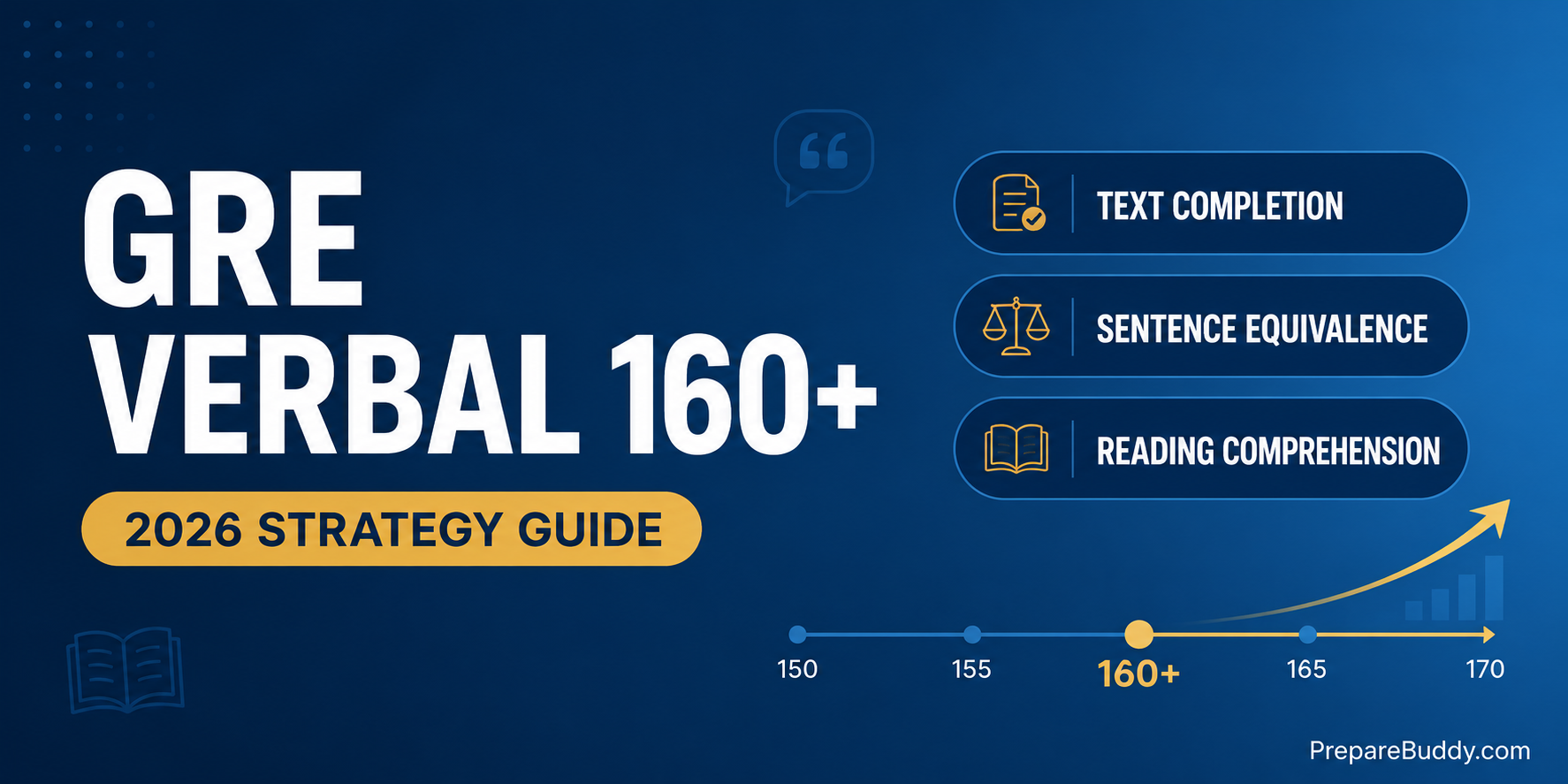
Here is the uncomfortable truth most GRE retakers discover too late: the Quant section is where you lose time, but the Verbal section is where you lose admission. A 160+ on GRE Verbal Reasoning sits around the 86th percentile — and for competitive humanities, social science, law-adjacent, and top MBA-feeder programs, it is the number that separates a "complete" application from a "we regret to inform you." Most test-takers plateau in the low 150s not because their vocabulary is weak, but because they never learned to read the way the GRE actually rewards.
This guide breaks down exactly how to score 160+ on GRE Verbal Reasoning in 2026: the section-adaptive scoring logic, all three question types, a question-by-question strategy, and an 8-week framework you can start this week.
What a 160+ GRE Verbal Score Actually Means
GRE Verbal Reasoning is scored on a 130–170 scale in one-point increments. The median sits around 150–151, which is why crossing into the 160s puts you ahead of roughly 85% of test-takers worldwide. Here is how the scores map to percentiles and program competitiveness (ETS percentiles, approximate):
| Verbal Score | Approx. Percentile | What It Unlocks |
|---|---|---|
| 168–170 | 98th–99th | Top humanities/PhD programs, fellowships |
| 163–167 | 92nd–96th | Highly competitive MA/PhD, top law-adjacent |
| 160–162 | 86th–90th | Strong applications at most top-50 programs |
| 155–159 | 67th–80th | Competitive at many funded programs |
| 150–154 | 47th–63rd | Around the median; safe for many programs |
The takeaway: a jump from 152 to 160 is only eight raw points, but it moves you from the 55th percentile to the 86th. Every point in the 150s is worth more than a point anywhere else on the scale.
Understand the Section-Adaptive Format Before You Study
The GRE has been section-level adaptive since the September 2023 shortened format, and that is still how it works in 2026. Verbal Reasoning has two sections totalling 27 questions. Your performance on the first section determines the difficulty — and the scoring ceiling — of the second:
| Stage | What Happens | Effect on Your Score |
|---|---|---|
| Section 1 (baseline) | A fixed set of medium-difficulty questions everyone sees | Determines which difficulty tier you unlock next |
| Score ≥ ~67% correct | Section 2 serves a HARD question set | Opens the 160–170 scoring band |
| Score ~33–67% | Section 2 serves a MEDIUM set | Caps you roughly in the 150–160 band |
| Score < ~33% | Section 2 serves an EASY set | Limits the ceiling to the lower band |
The strategic consequence is enormous: Section 1 is the most important block of questions on the entire Verbal test. You cannot "make up" a weak first section later, because a strong Section 2 simply will not be offered to you. Practising on a platform that replicates real GRE/GMAT/SAT section-level adaptive algorithms — like PrepareBuddy's adaptive testing engine — is the only way to rehearse this pressure honestly.
The Three GRE Verbal Question Types (and How to Beat Each)
1. Text Completion (TC)
You fill one, two, or three blanks in a passage from word banks. There is no partial credit — on a three-blank question you must get all three right. The trap is choosing words that "sound right" rather than words the passage logically demands.
Strategy: Read the whole sentence first and predict your own word for each blank before looking at the options. Hunt for the "pivot" words — although, however, despite, because, therefore — that signal whether a blank continues or reverses the idea. For multi-blank questions, lock in the blank you are most confident about first; it constrains the others.
2. Sentence Equivalence (SE)
One blank, six options, and you must pick the two words that produce sentences with equivalent meaning. Again, no partial credit.
Strategy: Predict the meaning of the blank, then look for a synonym pair. A word with no synonymous partner in the list is a distractor by definition, no matter how well it fits. This is a vocabulary-in-context skill, not a memorisation contest — but a strong high-frequency GRE word list still pays off here more than anywhere else.
3. Reading Comprehension (RC)
Roughly half the section. Passages come with standard multiple-choice, multi-select questions (one to three correct answers, all-or-nothing), and select-in-passage questions where you click the sentence that fits a description.
Strategy: Read for structure, not detail. On the first pass, map the author's purpose and the function of each paragraph — you can always return for specifics. For "inference" and "the author would most likely agree" questions, the right answer is the one you can defend with a specific line; eliminate anything that requires outside assumptions.
An 8-Week Framework to Reach 160+
- Weeks 1–2 — Diagnose and baseline. Take a full timed Verbal section to find your real starting score and your weakest question type. A free diagnostic test gives you an honest number instead of a guess.
- Weeks 3–4 — Build the engine. Drill high-frequency GRE vocabulary in context (never flashcards alone) and do focused sets of TC and SE until your accuracy on two- and three-blank questions stabilises above 70%.
- Weeks 5–6 — Master Reading Comprehension. Shift to RC-heavy practice. Time yourself: aim for roughly 1.5 minutes per question across the section so dense passages don't drain your clock.
- Weeks 7–8 — Simulate and refine. Take full, section-adaptive practice tests under real conditions. Review every wrong answer until you can articulate why the correct option wins and the trap fails — that error log is where the last 8 points live.
How PrepareBuddy Helps You Hit 160+
Generic question banks recycle the same few hundred items, so you end up memorising answers instead of building skill. PrepareBuddy generates unlimited, authentic GRE Verbal practice using a 120-billion-parameter AI model, with every question covering the real GRE types — Text Completion, Sentence Equivalence, Reading Comprehension, multi-select, and select-in-passage.
What makes the difference for a 160+ push:
- Real section-level adaptive simulation — GRE practice on PrepareBuddy mirrors the September 2023 algorithm, so you rehearse the actual "Section 1 sets your ceiling" pressure.
- Verified answer keys — every verbal item passes a cross-model consensus check (two independent AI models must agree on the answer), so you are not learning from flawed keys.
- A 24/7 AI Tutor that explains why each distractor is wrong and remembers where you keep slipping.
- Performance analytics that pinpoint whether TC, SE, or RC is costing you the most points — so your study time goes where it moves the score.
Frequently Asked Questions
Is 160 a good GRE Verbal score?
Yes. A 160 on GRE Verbal Reasoning is roughly the 86th percentile, meaning you scored higher than about 85% of test-takers. It is a strong, competitive number for most top programs, though the most selective humanities PhD programs often look for 163+.
How is GRE Verbal different from GRE Quant for scoring?
Both are scored 130–170, but the percentile curves differ. Because Verbal scores cluster lower overall, a 160 Verbal is a higher percentile (~86th) than a 160 Quant. Many programs weigh Verbal more heavily for non-STEM fields.
How long does it take to improve GRE Verbal by 8–10 points?
For most committed students, a 6–8 week focused plan with daily practice and rigorous error review is enough to move from the low 150s into the 160s. Vocabulary-in-context work and adaptive full-length practice are the highest-leverage activities.
Can I practise GRE Verbal for free?
Yes. You can start with a free practice test and a free diagnostic to find your baseline before committing to a full study plan.
Start Your 160+ Verbal Push Today
The gap between a 152 and a 160 is not talent — it is targeted, adaptive practice and a disciplined error log. Take an honest baseline, drill the three question types deliberately, and rehearse under real section-adaptive conditions.
Take a free GRE Verbal practice test on PrepareBuddy to see where you stand, or sign up free — first month free, no credit card required — to start your full adaptive study plan today.


Join the Discussion