
Most nurses and doctors don't fail OET. They fail OET Listening. AHPRA, the NMC, the Medical Board of Australia, the Nursing and Midwifery Council of Ireland and the Irish Medical Council all require Grade B (350+) in every sub-test — and Listening is where the wheels come off first. The audio plays once. You write while you listen. The accents rotate between British, Australian, Irish and North American clinicians inside a single section. And 42 marks are decided in 50 minutes.
This is the 2026 strategy guide for scoring Grade B (350+) in OET Listening — broken down by Part A, Part B, and Part C, with the band descriptors, the time math, and the specific drills that actually move the score.
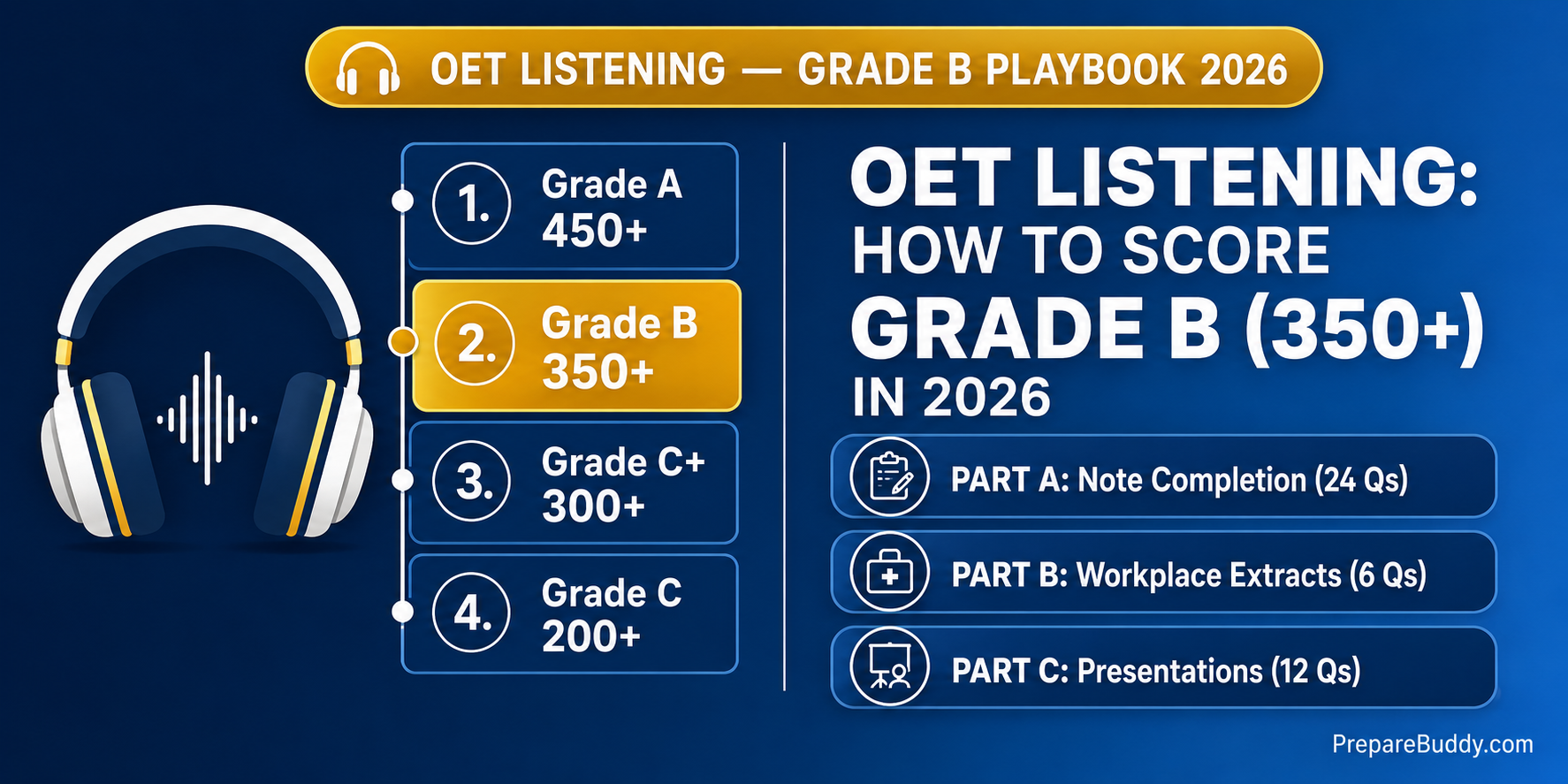
The OET Listening 2026 format at a glance
OET Listening is the first sub-test of test day. It has three parts, 42 marks total, and runs for roughly 50 minutes including the reading time before each section.
| Part | What you hear | What you do | Questions | Reading time |
|---|---|---|---|---|
| Part A | 2 consultation extracts (clinician + patient) | Complete the health professional's notes | 24 (12 per extract) | 30 seconds before each |
| Part B | 6 short workplace extracts (handovers, briefings, team meetings) | Three-option multiple choice | 6 (1 per extract) | 15 seconds per question |
| Part C | 2 longer presentations or interviews on healthcare topics | Three-option multiple choice on detail, opinion and inference | 12 (6 per extract) | ~90 seconds before each |
One play. No rewind. Healthcare-specific vocabulary across 12 professions — medicine, nursing, dentistry, pharmacy, physiotherapy, occupational therapy, optometry, podiatry, radiography, dietetics, speech pathology, and veterinary science.
What Grade B (350+) actually means in numbers
OET reports a 0–500 score per sub-test, and a letter grade. Grade B is the boundary most regulators care about. Here is the realistic mark conversion based on the published OET 2025 banding:
| OET Grade | Numeric Score | Raw marks (out of 42) | CEFR | Who accepts it |
|---|---|---|---|---|
| A | 450–500 | 40–42 | C2 | All regulators (with margin) |
| B | 350–440 | 30–39 | C1 | AHPRA, NMC, NMBI, IMC, GMC, DHA |
| C+ | 300–340 | 26–29 | B2 | Some pharmacy / OT boards only |
| C | 200–290 | 18–25 | B1 | Generally not accepted |
The practical target: 30 of 42 marks. That's roughly 18/24 on Part A, 4/6 on Part B, and 8/12 on Part C. Or stronger splits anywhere those marks land.
Part A — the section where Grade B is won or lost
Part A is 24 of the 42 marks — 57% of the test. Two consultations, twelve gaps in the health professional's notes per extract. You write while you listen, and the marker only accepts spellings that a healthcare professional would actually write in a chart.
What the marker is looking for
- Exact medical terminology. "BP" is fine. "blood pressure" is fine. "presure" is not.
- Correct units and frequency. 5mg twice daily is not the same answer as 5mg.
- Specific symptom descriptors. "sharp pain right lower quadrant" beats "stomach hurts."
- Patient-reported timeframes. If they say "for the past three weeks," you write three weeks, not recent.
The Part A drill that actually works
Use the 30 seconds of reading time to predict the grammatical category of every gap — noun, verb, adjective, number, duration — and circle the heading it sits under. Then listen for the trigger phrase that signals the gap is next: "started about," "complains of," "history of," "currently taking," "reports." Healthcare consultations follow a predictable history-of-presenting-complaint structure. Mark the structure, then listen for the slot-filler.
Part B — six chances to bank six easy marks
Part B looks light at six marks but it's the cheapest place to add four to six points if you train one specific habit: read the question stem and all three options before the audio starts. You have 15 seconds. Use every one of them.
The traps are predictable. The question almost always asks the speaker's main point, the team's agreed action, or the reason behind a decision. Distractor options are usually things the audio mentions but doesn't endorse — a problem raised then dismissed, a treatment considered then rejected.
| Part B trap | What you'll hear | What the right answer sounds like |
|---|---|---|
| Considered then rejected | "We thought about X, but actually…" | The "actually" clause, not X |
| Mentioned by wrong speaker | Junior staff suggests Y, senior overrules | The senior's recommendation |
| Paraphrased agreement | "That makes sense" / "I'd go with that" | The proposal that just preceded the agreement |
Part C — where Grade A candidates separate from Grade B
Part C is two longer pieces — a presentation, an interview, or a journal-style monologue from a senior clinician. Six questions each. The questions move beyond comprehension into opinion, inference, and attitude.
The shift in 2026: questions increasingly target the speaker's stance on emerging treatments, AI in clinical practice, antibiotic stewardship, and patient communication models. You need to track how the speaker feels, not just what they say.
The reliable C-level drill: while listening, jot a single-character symbol next to each gap — + for positive stance, − for negative, ? for uncertain, ! for emphasis. After the audio ends, your symbol map answers attitude questions in seconds.
The 8-week Grade B plan
| Weeks | Focus | Daily drill | Mock cadence |
|---|---|---|---|
| 1–2 | Part A note-taking shorthand | 30 minutes of consultations, hand-write notes only | 1 timed Part A only |
| 3–4 | Part B speed-reading the stem | 10 Part B extracts back-to-back | 1 timed Part A + B |
| 5–6 | Part C stance tracking | 1 medical podcast + symbol-map exercise | 1 full timed mock per week |
| 7–8 | Test-day rehearsal | 2 full mocks under exam conditions | 2 full mocks + section analysis |
How PrepareBuddy's OET Listening engine is built for Grade B
The April 2026 OET overhaul on PrepareBuddy landed the platform on real-OET-2025 parity for generation, scoring, and feedback. A few things matter specifically for Listening:
- Cambridge-style narrator scaffolding (May 2026). Every OET Listening test uses a reserved UK female narrator voice for the master intro, Part A/B/C section intros, reading-time pauses, "Now listen carefully" cues, and end-of-section transitions. The cadence is the cadence you'll hear on test day — not a stripped-down passage with no framing.
- 30+ English accents across the speaker pool — British, Australian, Irish, North American, South African and Indian-English clinicians, rotated across consultations so you train for the accent variation that real OET throws at you.
- 360 distinct profession × topic combinations before any repeat. Test 1 = Medicine × pandemic preparedness, Test 13 = Medicine × medical ethics, Test 30 = Occupational Therapy × interprofessional collaboration. You don't memorise a question bank — you build genuine listening range.
- 95% AI scoring accuracy aligned with real OET grading rubrics, so your Grade B band estimate from mock day is the one you'll actually see on score release.
- Projected grade in 4 weeks. The results page shows your current grade, your projected grade at current trajectory based on your last 5 sittings, the weakest section with gap-to-next-grade, and days-to-next-band at your current pace. No fake optimism — if the trend is flat or declining, no projection is shown.
The Grade B mindset shift
Most candidates studying for OET Listening practise listening. Grade B candidates practise note-taking under pressure in healthcare English. Those are different skills. One you build by watching ER. The other you build by drilling Part A consultations until your shorthand for "patient denies chest pain on exertion" is faster than your handwriting.
Try a free OET Listening test with full AI scoring and band-projected feedback at PrepareBuddy's free practice tests, or explore the full OET feature suite — including AI Writing Analysis, Voice AI role-play scoring, and the 360-combination test generator. For institutional OET preparation at coaching centers and language schools, the white-label platform deploys in 24–48 hours.
Grade B is 30 marks out of 42. That's the entire game. Now go drill Part A.


Join the Discussion