

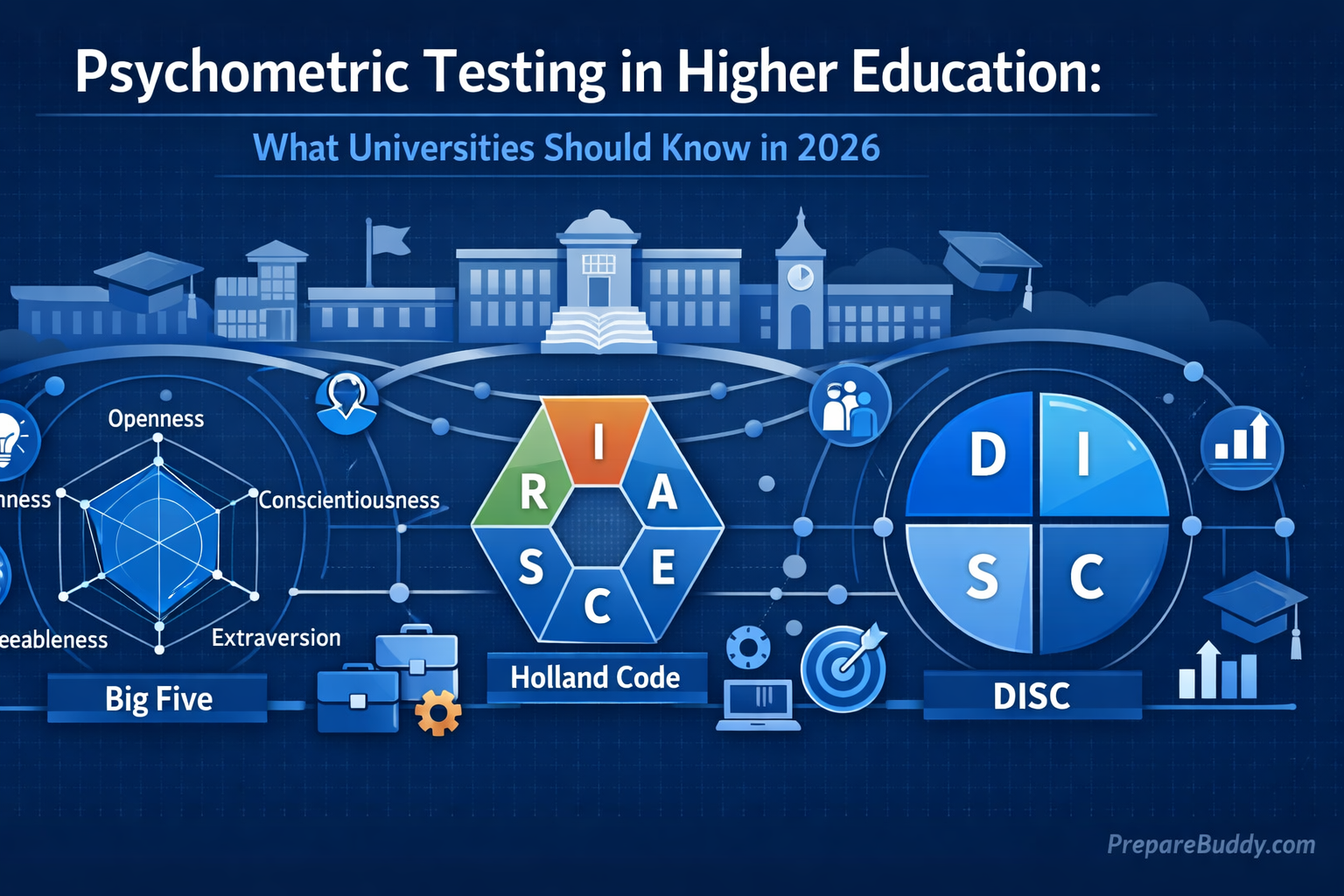
Only 34% of university graduates feel their degree aligned with their actual career interests, according to recent workforce studies. The gap between academic preparation and career satisfaction points to a fundamental problem: most universities help students learn what to study but rarely help them understand why a particular path fits them. Psychometric testing in higher education is changing that — giving universities the tools to guide students toward careers that match their personality, interests, and emotional strengths.
Why Universities Are Adopting Psychometric Testing
Career services departments face a persistent challenge. Students arrive uncertain about their direction, change majors multiple times, and graduate without a clear professional identity. Traditional academic advising focuses on course requirements and GPA thresholds, but it misses the deeper question: what kind of work environment, cognitive style, and interpersonal dynamic will help this student thrive?
Psychometric assessments answer these questions with validated, research-backed frameworks. Unlike informal career quizzes, validated psychometric instruments like the Big Five (OCEAN), Holland Code (RIASEC), HEXACO, and DISC provide scientifically grounded insights into personality traits, career interests, and workplace behavior patterns.
The Seven Frameworks That Matter for Student Development
Modern psychometric platforms offer multiple assessment frameworks, each measuring different dimensions of a student's profile. Here's how they compare:
| Assessment Framework | What It Measures | Best Use Case | Questions |
|---|---|---|---|
| Big Five (OCEAN) | 5 personality factors + 30 facets | Deep personality profiling | 50-120 |
| Holland Code (RIASEC) | 6 career interest types | Career matching (1,000+ occupations) | 24-84 |
| HEXACO | 6 factors including Honesty-Humility | Ethics and integrity assessment | 60-200 |
| DISC | 4 behavioral styles | Workplace behavior prediction | 24-48 |
| MBTI | 4 dichotomies, 16 types | Type-based self-awareness | 70-93 |
| Emotional Intelligence | 5 EQ dimensions | Leadership and social skills | 40-100 |
| TCI | 4 temperament + 3 character | Clinical personality analysis | Variable |
The key advantage of using multiple frameworks together is cross-framework analysis. For example, a student scoring high in Openness on the Big Five and Artistic (A) on the Holland Code shows a strong creative drive — pointing toward design, media, or arts-based careers. When Conscientiousness is also high alongside a Conventional (C) Holland Code, structured roles in finance or administration may be a natural fit.
How AI Transforms Raw Assessment Data into Career Guidance
Traditional psychometric testing stops at scores and percentile charts. AI-powered platforms take it further by analyzing combined assessment results to generate personalized career recommendations, study abroad suggestions, and personal development priorities.
For instance, a student with a Holland Code of RIA (Realistic-Investigative-Artistic), high Openness, and strong self-awareness might receive recommendations for architecture programs in Germany, industrial design courses in the Netherlands, or engineering-with-design specializations in Australia — complete with reasoning tied to their specific profile.
This level of specificity transforms career counseling from a generic conversation into a data-driven, personalized session. Counselors spend less time administering tests and more time interpreting results and guiding decisions.
Psychometric Testing as a University Differentiator
Universities competing for international students need more than academic rankings to stand out. Integrating psychometric assessments into the student experience creates a measurable differentiation advantage:
| Service Tier | What's Included | Value to Students |
|---|---|---|
| Basic Language Prep | IELTS/TOEFL preparation only | Standard test scores |
| Career Discovery | Language tests + Holland Code | Know what to study |
| Professional | Language tests + Big Five + DISC | Know yourself at work |
| Complete | All assessments + AI recommendations | Premium holistic guidance |
Institutions offering the Complete tier report up to 60% higher student retention and significantly stronger student satisfaction scores. The reason is straightforward: students who understand their own strengths and career direction stay more engaged throughout their academic journey.
What to Look for in a Psychometric Testing Platform
Not all psychometric tools are created equal. When evaluating platforms for institutional deployment, universities should assess these capabilities:
Scientific Validation: Ensure the platform uses validated frameworks (Big Five, RIASEC, HEXACO) rather than proprietary or unvalidated quiz-style assessments. Validated instruments have decades of peer-reviewed research supporting their reliability.
Cross-Framework Analysis: The real power of psychometric testing emerges when multiple assessments are correlated. Look for platforms that map Big Five traits against Holland Code interests, DISC behavioral styles, and EQ dimensions to generate integrated insights.
AI-Powered Recommendations: Static score reports are not enough. Modern platforms use AI to generate actionable career paths, study program suggestions, and development plans based on combined assessment data.
White-Label Branding: For universities deploying assessments under their own brand, white-label capabilities are essential. Professional PDF reports should carry the institution's logo, colors, and identity — not the vendor's.
Integration with Student Journey: Psychometric data is most valuable when connected to the broader student lifecycle. Platforms that integrate personality profiles with study abroad pipeline management, university recommendations, and counselor dashboards deliver far more value than standalone assessment tools.
How Leading Platforms Compare
| Feature | PrepareBuddy | 16Personalities | Truity | MBTI Official |
|---|---|---|---|---|
| Big Five (30 facets) | Yes | No | Partial | No |
| Holland Code (RIASEC) | Yes | No | Yes | No |
| HEXACO | Yes | No | No | No |
| DISC | Yes | No | No | No |
| EQ Assessment | Yes | No | No | No |
| Cross-Framework Analysis | Yes | No | No | No |
| AI Career Recommendations | Yes | Limited | Limited | No |
| White-Label Reports | Yes | No | No | No |
| Language Test Integration | Yes | No | No | No |
Getting Started with Institutional Psychometric Testing
Implementing psychometric testing does not require a massive IT overhaul. Modern platforms deploy within 24-48 hours with white-label branding, and universities can start with a single cohort before scaling institution-wide.
The typical implementation path looks like this: select the assessment frameworks relevant to your student population, configure branded PDF reports with your institution's identity, pilot with career services or a specific department, then expand based on student engagement data and counselor feedback.
For universities already using AI-powered assessment tools for academic grading, adding psychometric testing creates a comprehensive student development ecosystem — from academic evaluation to career guidance, all under one platform.
Frequently Asked Questions
Are psychometric assessments scientifically validated for university students?
Yes. The Big Five, Holland Code (RIASEC), and HEXACO frameworks have decades of peer-reviewed research validating their reliability and predictive accuracy across diverse populations, including university-aged students.
How long does it take for students to complete a psychometric assessment?
Individual assessments take 15-30 minutes to complete. Students can save progress and resume later. A comprehensive battery covering Big Five, Holland Code, and EQ typically takes 60-90 minutes total.
Can universities brand the assessments and reports with their own identity?
With a white-label platform like PrepareBuddy's psychometric testing module, universities get fully branded assessments, PDF reports with institutional logos, and custom domain hosting — with zero vendor branding visible to students.
Ready to add psychometric testing to your university's student services? Schedule a demo to see how 200+ institutions are using AI-powered assessments to improve student outcomes and career readiness.


Join the Discussion