

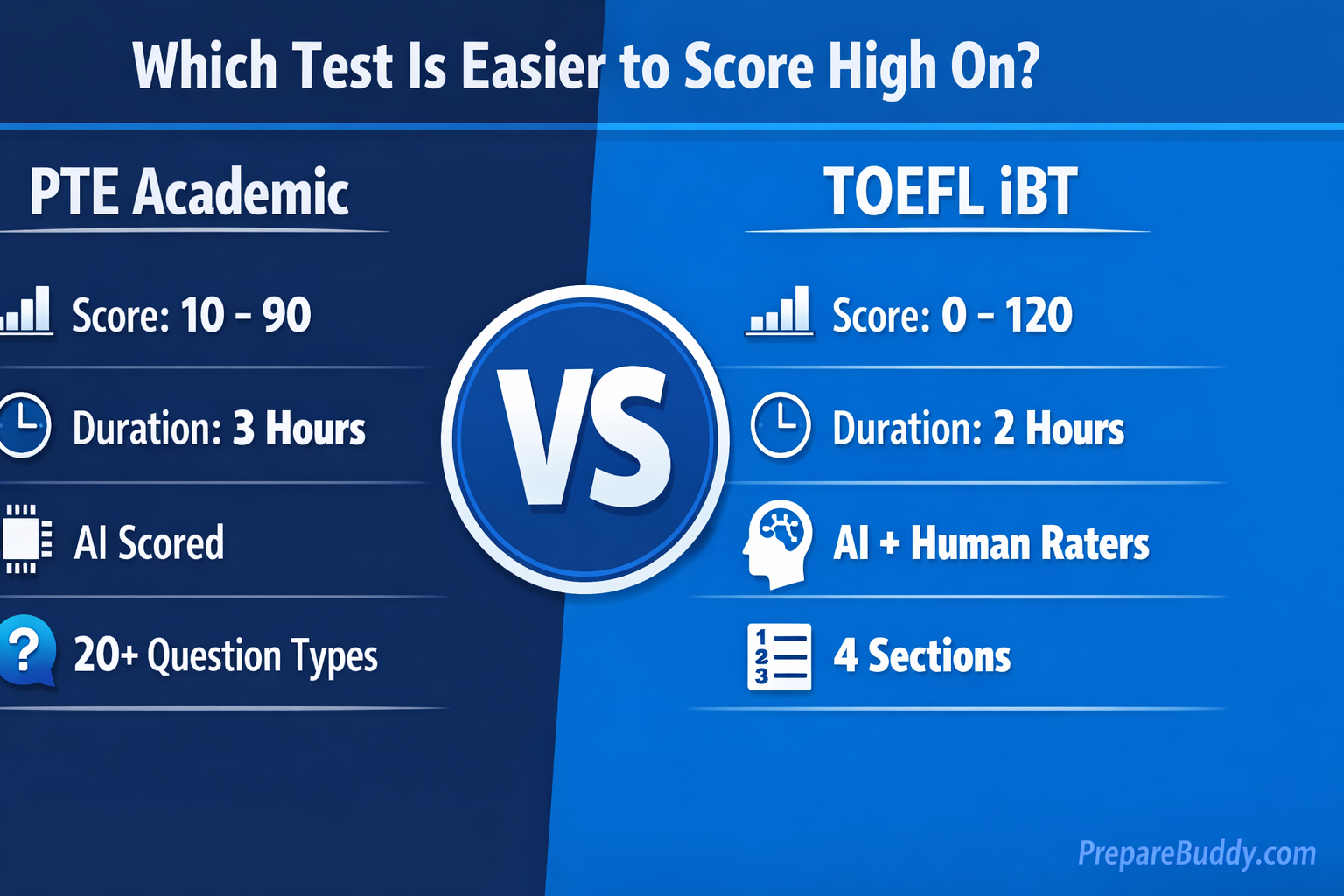
You need a strong English proficiency score for your dream university, but you're stuck choosing between PTE Academic and TOEFL iBT. Both are computer-based, both are widely accepted, and both test the same four skills. So which one actually gives you a better shot at a high score? The answer depends on your strengths as a test-taker — and understanding the key differences can save you months of preparation time.
PTE Academic vs TOEFL: Quick Comparison
| Feature | PTE Academic | TOEFL iBT |
|---|---|---|
| Test Duration | ~3 hours | ~2 hours |
| Score Range | 10–90 | 0–120 (30 per section) |
| Sections | Speaking & Writing, Reading, Listening | Reading, Listening, Speaking, Writing |
| Scoring Method | 100% AI-scored | AI + human raters (speaking & writing) |
| Results Available | Typically 1–5 business days | 6–10 days |
| Test Format | Computer-based, test center | Computer-based, test center or home |
| Accepted By | 3,000+ institutions worldwide | 12,000+ institutions worldwide |
| Test Fee | ~$225–270 USD (varies by country) | ~$200–310 USD (varies by country) |
Test Format: Where the Real Differences Emerge
PTE Academic Format
PTE Academic combines speaking and writing into a single integrated section at the start of the test. This is unusual — you begin by speaking into a microphone and typing responses before moving to reading and listening. The test uses 20+ question types across its sections, including tasks like Read Aloud, Repeat Sentence, Describe Image, Summarize Written Text, and Re-tell Lecture. Many tasks contribute scores to multiple skills simultaneously. For example, a Read Aloud task scores both your speaking and reading abilities.
TOEFL iBT Format
TOEFL iBT follows a more traditional four-section structure: Reading (20 questions, ~35 minutes), Listening (28 questions, ~36 minutes), Speaking (4 tasks, ~16 minutes), and Writing (2 tasks, ~29 minutes). The question types are more straightforward — primarily multiple choice for reading and listening, recorded responses for speaking, and typed essays for writing. Each section scores independently on a 0–30 scale.
Which Test Is Easier for Speaking?
This is often the deciding factor. PTE Academic speaking tasks are recorded and scored entirely by AI. There is no human examiner listening to your response. This means the AI evaluates pronunciation clarity, oral fluency, and content — consistently, every time. If you have clear pronunciation but get nervous talking to people, PTE's computer-based speaking may work in your favor.
TOEFL speaking also uses a computer (you record responses), but scoring involves a combination of AI and human raters. TOEFL speaking tasks include integrated tasks where you read a passage, listen to a lecture, and then respond — testing your ability to synthesize information under time pressure.
| Speaking Aspect | PTE Academic | TOEFL iBT |
|---|---|---|
| Number of Tasks | 5 task types (Read Aloud, Repeat Sentence, Describe Image, Re-tell Lecture, Answer Short Question) | 4 tasks (1 independent, 3 integrated) |
| Scoring | AI-only | AI + human raters |
| Key Challenge | Microphone sensitivity, pacing | Synthesizing reading + listening + speaking |
| Advantage For | Clear pronunciation, fast readers | Strong note-takers, analytical thinkers |
Which Test Is Easier for Writing?
PTE Academic writing includes Summarize Written Text (one sentence summary in 10 minutes) and Write Essay (200–300 words in 20 minutes). The essay is shorter than TOEFL's, and the one-sentence summary task is unique to PTE — it rewards concise, grammatically accurate writing.
TOEFL writing has two tasks: an Integrated Writing task (read a passage, listen to a lecture, write a response comparing them) and the newer "Writing for an Academic Discussion" task where you contribute to an online classroom discussion. TOEFL essays are generally expected to be longer and more detailed.
If you're a concise writer who excels at grammar, PTE's shorter writing tasks may suit you. If you're comfortable with longer, argument-driven essays and can synthesize information from multiple sources, TOEFL writing plays to your strengths.
Which Test Is Easier for Reading?
PTE reading includes multiple question types: Multiple Choice, Re-order Paragraphs, and Fill in the Blanks. The Re-order Paragraphs task is notoriously challenging — you must arrange jumbled paragraph chunks into logical order. Fill in the Blanks tests vocabulary and collocations in context.
TOEFL reading is more straightforward: you read academic passages and answer multiple-choice questions about main ideas, details, inferences, and vocabulary. If you're comfortable with standard reading comprehension, TOEFL's approach is more predictable.
Which Test Is Easier for Listening?
Both tests include academic lectures and conversations. PTE listening tasks are more varied — you'll encounter Summarize Spoken Text (write a summary of what you heard), Fill in the Blanks (type missing words from a transcript), Highlight Correct Summary, and Write from Dictation. The Write from Dictation task, where you type exactly what you hear, is particularly high-stakes because it contributes to both listening and writing scores.
TOEFL listening uses primarily multiple-choice questions after lectures and conversations. You can take notes during the audio, and questions test understanding of main ideas, details, speaker attitude, and organization. The question format is simpler, but the lectures can be long and dense.
Score Comparison: PTE vs TOEFL Equivalence
Understanding how scores translate between the two tests helps you set realistic targets:
| PTE Score | TOEFL Score | CEFR Level | Typical Requirement |
|---|---|---|---|
| 85–90 | 113–120 | C2 | Top-tier programs, medical schools |
| 79–84 | 102–112 | C1+ | Competitive graduate programs |
| 65–78 | 88–101 | C1 | Most graduate programs |
| 58–64 | 75–87 | B2+ | Many undergraduate programs |
| 50–57 | 60–74 | B2 | Foundation/pathway programs |
| 36–49 | 35–59 | B1 | Some diploma programs |
Who Should Choose PTE Academic?
PTE Academic tends to favor test-takers who have strong pronunciation and speak clearly, are comfortable with computer-based interaction and microphone recording, prefer shorter writing tasks with strict structure, want faster results (typically 1–5 business days), and are applying primarily to institutions in Australia, New Zealand, or the UK where PTE acceptance is particularly strong.
Who Should Choose TOEFL iBT?
TOEFL iBT tends to favor test-takers who are strong note-takers and can synthesize information from multiple sources, prefer standard reading comprehension formats, are comfortable with longer writing tasks, want the flexibility of a home edition option, and are applying to US universities where TOEFL has the longest acceptance history.
How to Prepare Effectively for Either Test
Regardless of which test you choose, preparation quality matters more than test selection. Here are strategies that work for both:
Practice with AI-scored feedback. Both PTE and TOEFL rely on AI scoring for at least some components. Practicing with AI-powered tools that evaluate your speaking pronunciation, fluency, and writing accuracy gives you an edge because the feedback mirrors what the actual test algorithm assesses. PrepareBuddy's platform provides Voice AI speaking practice with real-time pronunciation scoring across 30+ English accents and 48-emotion detection — the kind of detailed feedback that helps you understand exactly where to improve.
Take full-length practice tests under timed conditions. Both tests are marathons, not sprints. Stamina and time management are as important as language ability. Try a free practice test to benchmark your current level and identify which sections need the most work.
Focus on your weakest skill first. Your overall score is limited by your lowest section score. If speaking is your weak point, dedicate 60% of your prep time there. AI-powered study plans can personalize your preparation schedule based on diagnostic results.
Use score equivalence tables to set targets. If your target university accepts both tests, compare the required scores using the equivalence table above and choose whichever test gives you more room above the minimum.
The Bottom Line
Neither PTE Academic nor TOEFL iBT is objectively "easier" — they test the same skills through different formats. PTE rewards speed, pronunciation clarity, and comfort with varied task types. TOEFL rewards analytical thinking, note-taking ability, and structured essay writing. The test that's easier for you depends entirely on your individual strengths.
The best way to decide? Take a practice test for each and compare your scores. Start with a free AI-scored practice test on PrepareBuddy to see where you stand — for both PTE Academic and TOEFL iBT. Your results will tell you more than any comparison article ever could.


Join the Discussion