

You've decided to study in the United States — but what TOEFL iBT score do you actually need? The answer depends on which university you're targeting. A score of 80 might open doors at some schools, while Ivy League programs often expect 100+. This guide breaks down the exact TOEFL iBT score requirements for the top 50 US universities so you can set a realistic target and build a focused preparation plan.
How TOEFL iBT Scoring Works
The TOEFL iBT tests four English skills — Reading, Listening, Speaking, and Writing — each scored on a scale of 0 to 30, for a total score of 0 to 120. The test takes approximately 116 minutes. Most US universities set both a minimum total score and minimum section scores, so hitting the overall number isn't enough if one section falls short.
| Section | Score Range | Duration | Question Types |
|---|---|---|---|
| Reading | 0–30 | 35 min | 20 questions across 2 passages |
| Listening | 0–30 | 36 min | 28 questions (lectures + conversations) |
| Speaking | 0–30 | 16 min | 4 tasks (independent + integrated) |
| Writing | 0–30 | 29 min | 2 tasks (integrated + academic discussion) |
| Total | 0–120 | ~116 min |
TOEFL iBT Score Requirements: Top 50 US Universities
Below is a comprehensive table of TOEFL iBT minimum score requirements at the top 50 US universities. Note that requirements can vary by program — graduate programs, MBA programs, and STEM departments may have different thresholds. Always verify with the specific program you're applying to.
| Rank | University | Minimum TOEFL iBT | Section Minimums | Notes |
|---|---|---|---|---|
| 1 | Massachusetts Institute of Technology | 100 | 23 per section (recommended) | Some departments require higher |
| 2 | Stanford University | 100 | No official section mins | Highly competitive; aim 110+ |
| 3 | Harvard University | 100 | No official section mins | Most admits score 110+ |
| 4 | California Institute of Technology | 100 | No official section mins | STEM-heavy; strong writing valued |
| 5 | University of Chicago | 104 | 26 per section | Strict section requirements |
| 6 | University of Pennsylvania | 100 | No official section mins | Wharton MBA may differ |
| 7 | Princeton University | 100 | No official section mins | Some departments prefer higher |
| 8 | Yale University | 100 | 25+ speaking recommended | Graduate programs may vary |
| 9 | Duke University | 100 | No official section mins | Engineering programs competitive |
| 10 | Johns Hopkins University | 100 | 26 Reading, 26 Listening, 25 Writing, 25 Speaking | Section scores enforced |
| 11 | Northwestern University | 100 | No official section mins | Median admit ~108 |
| 12 | Columbia University | 100 | No official section mins | Highly competitive programs |
| 13 | Cornell University | 100 | 20 Writing, 15 Reading, 15 Listening, 22 Speaking | Section mins vary by college |
| 14 | University of California, Berkeley | 90 | No official section mins | Most admits score well above 90 |
| 15 | University of California, Los Angeles | 100 | 22 per section | Graduate programs may differ |
| 16 | Rice University | 100 | 20 per section | Section minimums enforced |
| 17 | Dartmouth College | 100 | No official section mins | Tuck MBA has separate reqs |
| 18 | Vanderbilt University | 100 | No official section mins | Competitive admit scores |
| 19 | University of Notre Dame | 100 | No official section mins | Recommended 25+ per section |
| 20 | University of Michigan, Ann Arbor | 100 | 23 Listening & Reading, 21 Speaking & Writing | Specific section thresholds |
| 21 | Georgetown University | 100 | No official section mins | SFS may require higher |
| 22 | Emory University | 100 | No official section mins | Graduate programs vary |
| 23 | University of Virginia | 90 | No official section mins | Competitive applicants score 100+ |
| 24 | Carnegie Mellon University | 100 | 25 per section | CS programs very competitive |
| 25 | Washington University in St. Louis | 100 | No official section mins | Olin Business has separate reqs |
| 26 | University of Southern California | 100 | 20 per section | Section scores enforced |
| 27 | New York University | 100 | No official section mins | Stern MBA may require higher |
| 28 | University of Florida | 80 | No official section mins | Lower threshold; competitive admits higher |
| 29 | University of North Carolina, Chapel Hill | 100 | No official section mins | Kenan-Flagler MBA separate |
| 30 | Wake Forest University | 100 | No official section mins | Strong writing scores valued |
| 31 | Tufts University | 100 | 25+ per section recommended | Fletcher School may differ |
| 32 | University of California, San Diego | 83 | No official section mins | STEM programs popular |
| 33 | Boston College | 100 | No official section mins | Competitive overall scores |
| 34 | University of Rochester | 100 | No official section mins | Simon Business separate |
| 35 | University of California, Davis | 80 | No official section mins | STEM-friendly threshold |
| 36 | Boston University | 90 | 20+ per section recommended | Some programs higher |
| 37 | University of Wisconsin, Madison | 95 | No official section mins | Engineering programs competitive |
| 38 | University of Texas, Austin | 79 | No official section mins | McCombs MBA separate reqs |
| 39 | University of Illinois, Urbana-Champaign | 103 | No official section mins | Top CS program; competitive |
| 40 | Georgia Institute of Technology | 90 | No official section mins | STEM-focused admissions |
| 41 | Purdue University | 80 | 20 per section | Engineering popular choice |
| 42 | Lehigh University | 90 | No official section mins | Business programs competitive |
| 43 | University of California, Irvine | 80 | No official section mins | Strong STEM programs |
| 44 | Northeastern University | 99 | No official section mins | Co-op program popular |
| 45 | University of California, Santa Barbara | 80 | No official section mins | Research-focused |
| 46 | Ohio State University | 79 | No official section mins | Large international community |
| 47 | University of Maryland, College Park | 100 | No official section mins | CS and engineering competitive |
| 48 | Rutgers University | 79 | No official section mins | Varies by school within Rutgers |
| 49 | University of Washington | 92 | No official section mins | Foster School of Business higher |
| 50 | University of Minnesota, Twin Cities | 79 | No official section mins | Carlson School separate |
Score Tiers: What Your TOEFL Score Unlocks
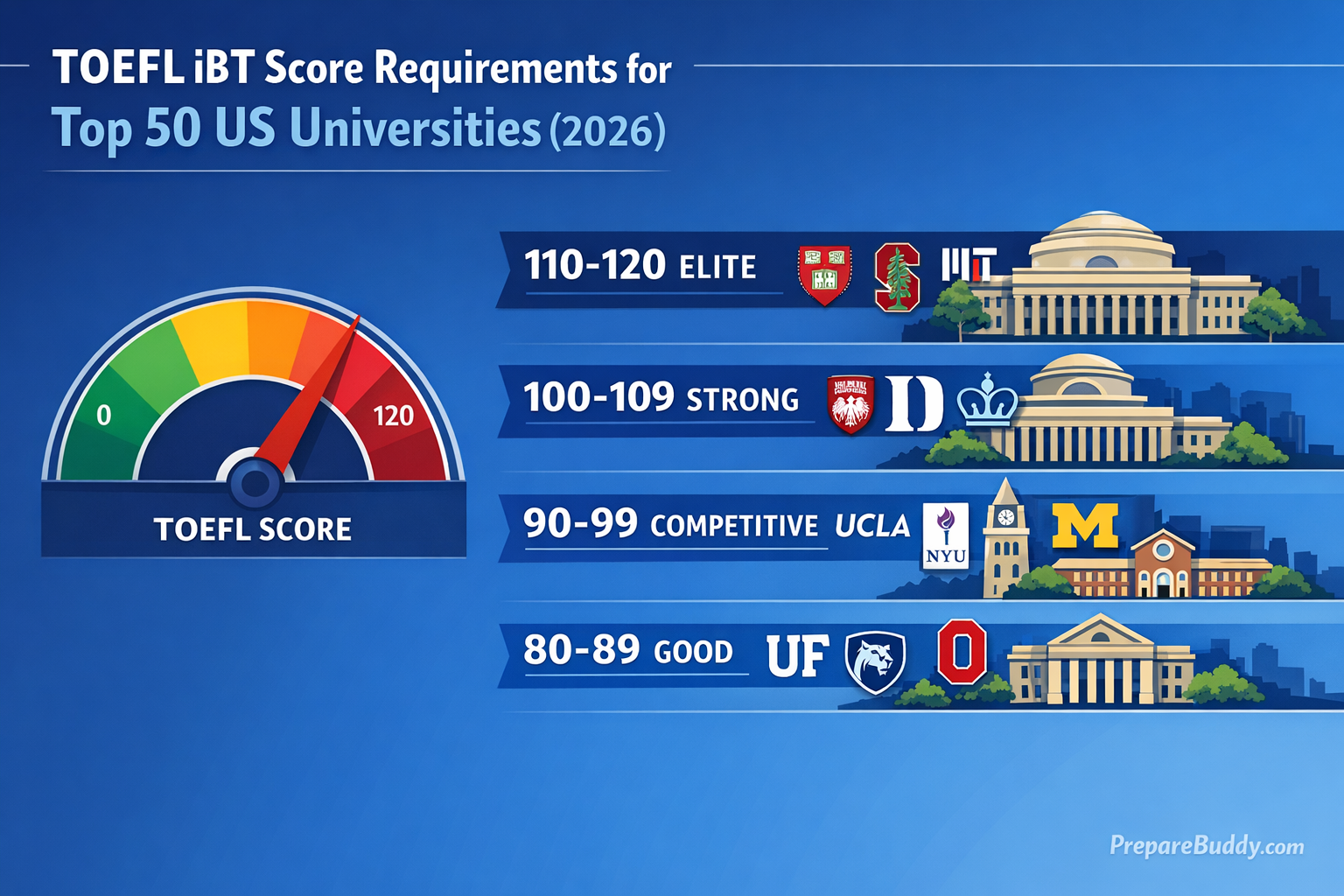
Not sure where you stand? Here's how different TOEFL iBT score ranges map to university tiers and opportunities:
| TOEFL iBT Range | Level | University Tier | Examples |
|---|---|---|---|
| 110–120 | Elite | Top 10 (Ivy League, Stanford, MIT) | Harvard, Stanford, MIT, Princeton |
| 100–109 | Strong | Top 11–30 | UCLA, Carnegie Mellon, NYU, Georgetown |
| 90–99 | Competitive | Top 30–40 | UC Berkeley, Georgia Tech, Boston University |
| 80–89 | Good | Top 40–50+ | UC Davis, Purdue, Ohio State, UT Austin |
| Below 80 | Limited options | Conditional admission or pathway programs | Foundation/bridge programs available |
Why Section Scores Matter as Much as Your Total
Here's a mistake many applicants make: they focus only on the total score. But universities like Johns Hopkins, Carnegie Mellon, and UCLA enforce minimum section scores. A total of 105 won't help if your Speaking score is 20 and the university requires 25. When preparing, identify your weakest section early and dedicate extra practice time to it.
The TOEFL iBT's four-section structure — Reading (20 questions), Listening (28 questions), Speaking (4 tasks), and Writing (2 tasks) — means each section demands a different preparation strategy. Speaking and Writing sections, which require productive language skills, are typically where students lose the most points.
5 Strategies to Hit Your Target TOEFL Score
1. Take a Diagnostic Test First
Before investing months in preparation, know your baseline. A free TOEFL practice test gives you section-by-section scores so you can identify gaps. PrepareBuddy's AI-scored practice tests use official TOEFL iBT scoring criteria to give you an accurate picture of where you stand.
2. Focus on Your Weakest Section
If your target school requires 100+ and you're scoring 85, don't spread your effort evenly. Identify which section has the most room for improvement and concentrate there. Going from 20 to 26 in Writing is usually easier than going from 28 to 30 in Reading.
3. Practice Under Real Test Conditions
The TOEFL iBT is 116 minutes of concentrated focus. Practice with timed, full-length tests that simulate the real experience. PrepareBuddy generates unlimited TOEFL iBT practice tests that match the current 2025 format, including adaptive question types and integrated tasks.
4. Use AI Feedback for Speaking and Writing
The hardest sections to self-study are Speaking and Writing because you need external feedback. PrepareBuddy's Voice AI technology provides real-time pronunciation scoring, fluency analysis, and detailed feedback on your spoken responses — evaluating the same criteria that official TOEFL raters use.
5. Track Progress with AI Study Plans
Set a target date and let an AI-generated study plan structure your preparation. Adaptive study plans adjust difficulty based on your performance, ensuring you're always practicing at the right level — not wasting time on questions that are too easy or too hard.
Match Your Score to the Right Universities
Once you have your TOEFL score, the next challenge is finding universities where you're a competitive applicant — considering not just English proficiency but also your academic profile. PrepareBuddy's AI-powered university matching system categorizes schools into Reach, Target, and Safety tiers based on your complete profile, including test scores, GPA, and preferences.
Ready to Start Preparing?
Knowing your target score is the first step. The next step is building a preparation plan that gets you there efficiently. Start with a free TOEFL practice test to see where you stand today, then use AI-powered practice to close the gap systematically.


Join the Discussion