

Over 3.5 million students take either the TOEFL or IELTS every year — and nearly half of them spend weeks agonizing over which test to choose before they even start studying. If you're reading this, you're probably in that camp right now. Here's the good news: by the end of this guide, you'll know exactly which test matches your destination country, learning style, and score goals.
TOEFL vs IELTS at a Glance
Before diving into the details, here's a side-by-side snapshot of the two biggest English proficiency tests in the world.
| Feature | TOEFL iBT | IELTS Academic |
|---|---|---|
| Full Name | Test of English as a Foreign Language (Internet-Based Test) | International English Language Testing System |
| Administrator | ETS (Educational Testing Service) | British Council / IDP / Cambridge |
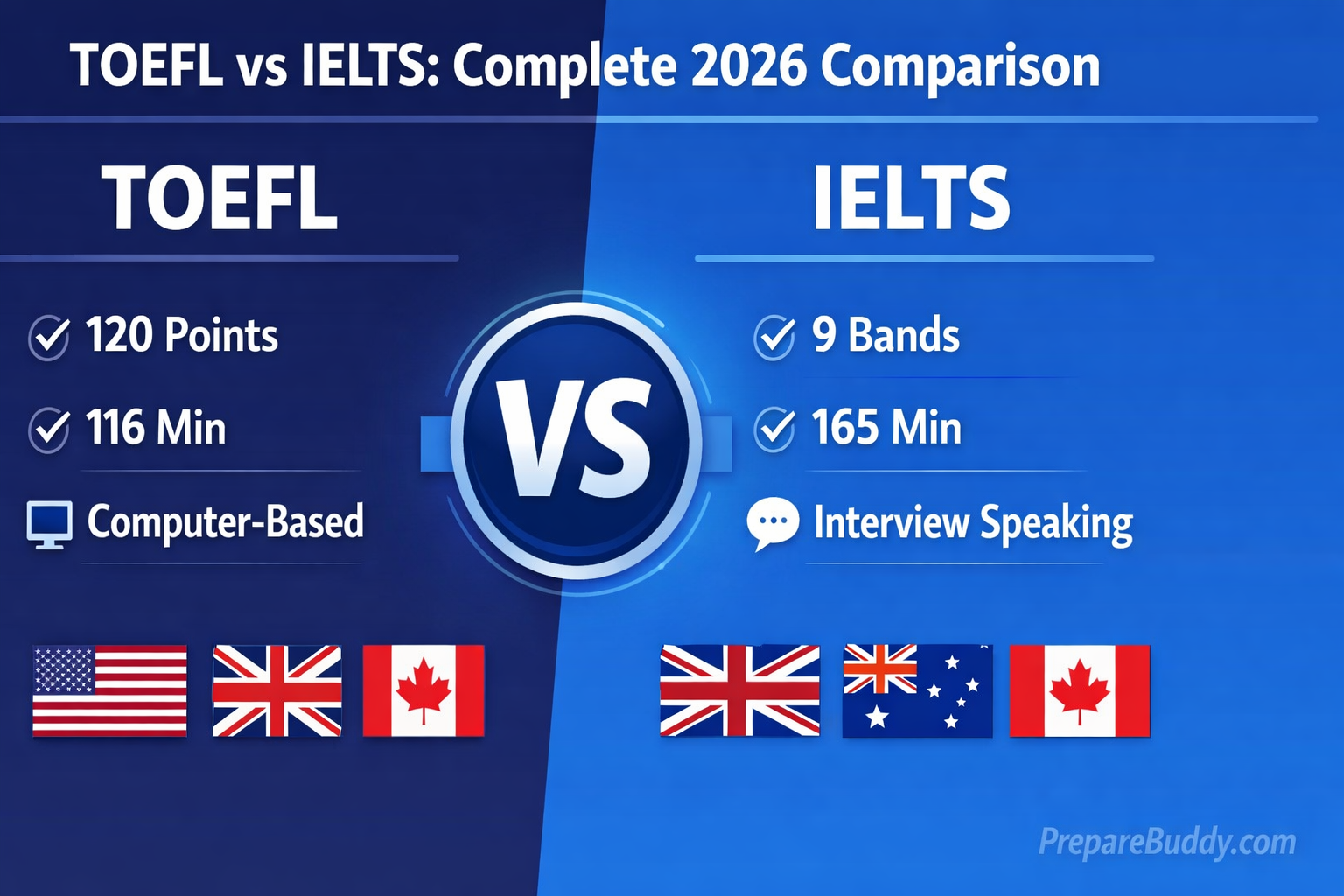
| Test Duration | ~2 hours (116 min) | ~2 hours 45 min (165 min) |
| Format | 100% computer-based | Computer or paper-based |
| Sections | Reading, Listening, Speaking, Writing | Listening, Reading, Writing, Speaking |
| Score Scale | 0–120 (30 per section) | 0–9 band (0.5 increments) |
| Speaking Format | Speak into a microphone (recorded) | Face-to-face interview with examiner |
| Writing Format | Type on computer | Handwrite (paper) or type (computer) |
| Test Fee | ~US $190–$210 | ~US $240–$260 |
| Score Validity | 2 years | 2 years |
| Results Turnaround | 4–8 days | 3–5 days (computer) / 13 days (paper) |
Score Conversion: TOEFL vs IELTS Equivalence
Universities and immigration authorities often accept both tests. Here's how scores translate based on ETS's official concordance data — this is the table you'll want to bookmark.
| IELTS Band | TOEFL iBT Score | Typical Requirement |
|---|---|---|
| 9.0 | 118–120 | Near-native proficiency |
| 8.5 | 115–117 | Top-tier programs (Oxford, MIT) |
| 8.0 | 110–114 | Competitive grad programs |
| 7.5 | 102–109 | Most graduate programs |
| 7.0 | 94–101 | Standard university admission |
| 6.5 | 79–93 | Undergraduate admission / pathway programs |
| 6.0 | 60–78 | Foundation / pre-sessional courses |
| 5.5 | 46–59 | Some pathway programs |
Pro tip: Don't assume a "6.5 overall" means the same flexibility in both tests. Many programs set minimum section scores — for example, "IELTS 7.0 with no band below 6.5" or "TOEFL 100 with 25+ in each section." Always check your target program's specific requirements.
Country-by-Country Acceptance: Which Test Works Where?
Your destination country is often the single biggest factor in choosing between TOEFL and IELTS. Here's how acceptance breaks down in 2026.
| Country | TOEFL Acceptance | IELTS Acceptance | Recommendation |
|---|---|---|---|
| United States | Preferred by most universities | Widely accepted (11,500+ institutions) | Either works; TOEFL slightly preferred |
| United Kingdom | Accepted by universities (not UKVI immigration) | Accepted for both universities and UKVI visas | IELTS if you need a visa-specific test |
| Canada | Accepted by universities and Express Entry | Accepted by universities and Express Entry | Both equally accepted |
| Australia | Accepted by universities | Accepted by universities and immigration | IELTS or PTE Academic preferred for migration |
UK visa note: For UK Tier 4 student visas, UKVI only accepts IELTS for below-degree-level courses. For degree-level and above, universities can accept TOEFL. Always confirm with your university's admissions office.
Section-by-Section Breakdown
Reading
TOEFL reading presents 2 academic passages with 20 questions in 35 minutes. IELTS gives you 3 passages with 40 questions in 60 minutes. The question types differ significantly: TOEFL relies heavily on multiple-choice and inference questions, while IELTS uses a wider variety — True/False/Not Given, matching headings, sentence completion, and summary completion.
If you're comfortable with multiple-choice formats and academic English, TOEFL reading may feel more straightforward. If you prefer varied question types and don't mind time pressure, IELTS reading could play to your strengths.
Listening
TOEFL listening features academic lectures and campus conversations — you hear the audio once and answer questions afterward. IELTS listening covers a broader range: everyday conversations, monologues, academic discussions, and lectures across 4 sections. You hear each recording once but get time to read questions beforehand.
A key difference: IELTS listening includes a wider range of accents (British, Australian, North American) while TOEFL primarily uses North American English. If you're more familiar with American accents, TOEFL has a slight edge. If you've trained across accents, IELTS is manageable.
Speaking
This is where the two tests diverge most. TOEFL speaking is recorded — you speak into a microphone in response to 4 tasks (some integrating reading and listening). IELTS speaking is a live, face-to-face interview lasting 11–14 minutes across 3 parts: introduction, long turn (cue card), and discussion.
Introverted test-takers or those who get nervous speaking to people often prefer TOEFL's microphone format. If you're more comfortable in natural conversation and can think on your feet, IELTS speaking may help you score higher. Either way, consistent practice with real-time feedback is essential — tools like PrepareBuddy's Voice AI provide instant pronunciation scoring and fluency analysis across 30+ English accents, helping you prepare for whichever format you choose.
Writing
TOEFL writing has 2 tasks: an integrated task (read + listen + write) and an academic discussion task. IELTS Academic writing also has 2 tasks: Task 1 (describe a chart, graph, or diagram) and Task 2 (essay). Both tests evaluate coherence, vocabulary, grammar, and task achievement — but TOEFL's integrated task specifically tests your ability to synthesize information from multiple sources.
If you're strong at summarizing and integrating ideas, TOEFL writing plays to that strength. If you prefer descriptive writing and essay argumentation, IELTS may be more comfortable. For either test, AI-powered writing feedback can help you identify weak spots before test day — PrepareBuddy's AI Writing Analysis scores your essays against official criteria with specific improvement suggestions.
Which Test Is "Easier"?
Let's be honest — this is the question everyone really wants answered. The truth is that neither test is objectively easier. They test different skills in different ways.
| Skill Area | Easier on TOEFL | Easier on IELTS |
|---|---|---|
| Reading | Fewer question types (mostly MCQ) | More time per question |
| Listening | Consistent American accent | Time to preview questions |
| Speaking | No face-to-face pressure | Natural conversation flow |
| Writing | Typing speed advantage | Task 1 graph description is formulaic |
| Overall | Better for test-takers who prefer screens | Better for test-takers who prefer variety |
The best way to decide? Take a practice test for each. PrepareBuddy offers free AI-scored practice tests for both TOEFL and IELTS, complete with section-by-section scoring against official criteria. Your practice scores will tell you more than any comparison article can.
How to Decide: A Quick Decision Framework
Still unsure? Run through these five questions:
1. Does your target program or visa require a specific test? If yes, that's your answer. Check your university's admissions page or your country's immigration website first.
2. Are you applying to the UK for a Tier 4 visa at below-degree level? You'll need IELTS (UKVI). For degree-level, either test works.
3. Do you prefer speaking to a microphone or to a person? Microphone → TOEFL. Person → IELTS.
4. Is your typing speed strong? TOEFL requires typed responses. If you write faster by hand, paper-based IELTS may give you an edge.
5. Which accent are you most comfortable with? American → TOEFL tends to suit you. British/Australian mix → IELTS listening won't throw you off.
Prepare for Either Test with AI-Powered Practice
Whichever test you choose, preparation quality matters more than the test itself. PrepareBuddy generates unlimited AI-powered practice tests for both TOEFL and IELTS, with content calibrated to 2025 official standards. Every speaking response gets instant pronunciation and fluency feedback. Every essay gets scored against official band descriptors or ETS rubrics. And with adaptive testing, your practice adjusts to your level — so you're always working on what matters most.
Over 50,000 students and 200+ institutions already use PrepareBuddy for test preparation. Try a free practice test now and see your estimated score before you commit to either exam.


Join the Discussion