

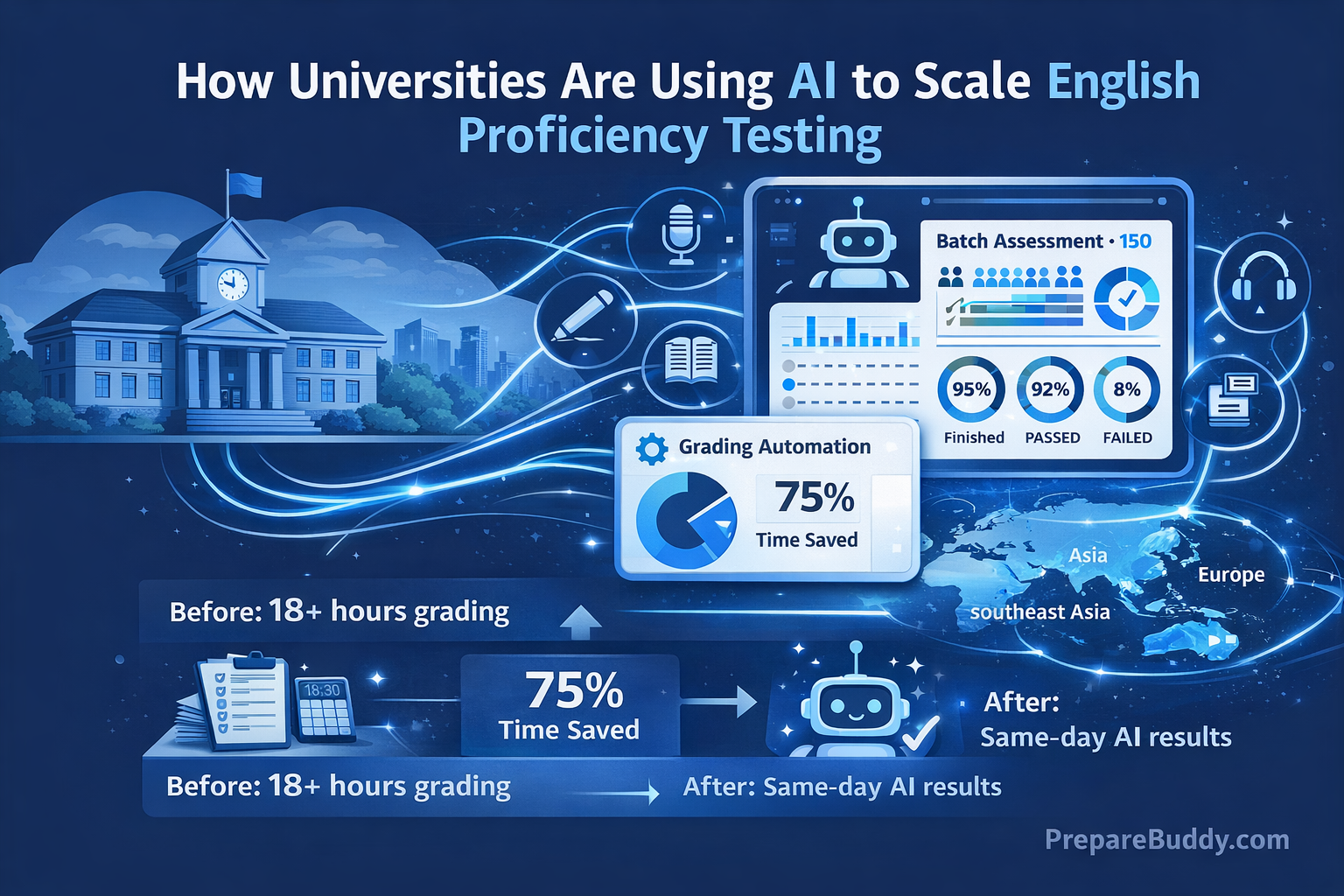
A single admissions cycle at a mid-sized university can generate thousands of English proficiency evaluations. When each assessment requires manual review by trained evaluators, the bottleneck isn't student ability — it's institutional capacity. Universities across Australia, Southeast Asia, the Middle East, and Europe are now turning to AI-powered assessment platforms to eliminate that bottleneck entirely.
The Scaling Problem in University Language Assessment
Traditional English proficiency testing at the institutional level faces three compounding challenges. First, evaluator availability is limited — qualified language assessors are expensive to hire and difficult to scale during peak admissions periods. Second, consistency suffers as evaluation fatigue sets in; a writing sample reviewed at 9 AM may receive different treatment than one reviewed at 4 PM. Third, turnaround times stretch from days to weeks, frustrating applicants and delaying enrollment decisions.
These aren't hypothetical problems. They directly affect yield rates, student satisfaction, and administrative costs. Universities that solve them gain a measurable competitive advantage in attracting international students.
What AI-Powered Language Assessment Actually Looks Like
AI-powered English proficiency testing isn't a chatbot asking vocabulary questions. Modern platforms evaluate all four language skills — reading, writing, listening, and speaking — using multi-model verification systems that achieve scoring accuracy comparable to human evaluators.
| Assessment Area | Traditional Approach | AI-Powered Approach | Impact |
|---|---|---|---|
| Writing Evaluation | Manual grading, 15-20 min per essay | AI analysis of coherence, grammar, vocabulary range | 75% time saved on grading |
| Speaking Assessment | Scheduled interviews with evaluators | Voice AI with real-time pronunciation scoring, 48-emotion detection | No scheduling bottleneck |
| Reading & Listening | Static paper-based tests | Adaptive testing that adjusts difficulty per student | More accurate placement |
| Score Reporting | Manual compilation, days to deliver | Instant AI-generated reports with sub-skill breakdown | Same-day results |
The key metric: platforms like PrepareBuddy's AI assessment system achieve 95% scoring accuracy through multi-model verification, meaning each response is evaluated by multiple AI models and cross-validated for consistency — something human evaluators physically cannot do at scale.
The Business Case: ROI That University Administrators Care About
Adopting AI-powered assessment isn't just a technology upgrade — it's a financial decision. Here's what the numbers look like based on data from 200+ institutions using AI-powered test preparation and assessment:
| Metric | Before AI Assessment | After AI Assessment |
|---|---|---|
| Grading time per batch | 18+ hours weekly | ~4 hours weekly (AI-assisted review) |
| Evaluator cost | Multiple full-time assessors | Reduced to oversight role |
| Score turnaround | 3-7 business days | Same day |
| Student satisfaction | Variable | 95% satisfaction rate |
| ROI timeline | — | 300% within 18 months |
The 18+ hours saved weekly on grading alone often justifies the investment. When you add faster enrollment processing, reduced evaluator hiring, and improved student experience, the case becomes difficult to argue against.
Beyond Standardized Tests: Institutional Language Proficiency
Many universities need more than IELTS or TOEFL equivalents. They need the ability to assess English proficiency on their own terms — for placement testing, progress monitoring, exit assessments, and pathway program evaluation.
Adaptive language testing addresses this by offering CEFR-aligned assessments (A1 through C2) across 11 languages, with difficulty that adjusts in real time based on each student's demonstrated ability. This means a single test can accurately place students anywhere on the proficiency spectrum, eliminating the need for multiple test versions or manual placement interviews.
For universities running English pathway programs, this creates a continuous assessment loop: students take a placement test on entry, receive AI-scored practice throughout their program, and complete an exit assessment — all within the same platform, all with consistent scoring criteria.
Batch Assessment: The Feature That Changes Everything
Perhaps the most transformative capability for universities is batch assessment — the ability to evaluate hundreds or thousands of student submissions simultaneously with AI-powered grading.
Instead of distributing essays across a team of evaluators and waiting for each to complete their stack, administrators upload an entire batch and receive scored, annotated results within hours. Each assessment includes detailed feedback on vocabulary usage, grammatical accuracy, coherence, and task response — the same feedback dimensions a human evaluator would assess, but delivered at scale and with perfect consistency.
This capability is particularly valuable during peak admissions periods, mid-term assessments, and program exit evaluations when volume spikes make manual grading impractical.
Voice AI: Solving the Speaking Assessment Bottleneck
Speaking assessments have traditionally been the hardest to scale. Each evaluation requires a trained interviewer, a scheduled time slot, and 10-15 minutes per student. For a university assessing 500 incoming international students, that's over 100 hours of interviewer time.
AI-powered Voice assessment eliminates this bottleneck entirely. Students complete speaking tasks at their convenience, and the AI evaluates pronunciation accuracy across 30+ English accents, fluency and pacing, content relevance and coherence, and emotional engagement through 48-emotion detection. The technology doesn't replace human judgment — it augments it. Evaluators can review flagged cases or borderline scores while the AI handles the bulk of routine assessments.
Implementation: Faster Than You'd Expect
One common concern is deployment complexity. Universities have existing LMS systems, student information databases, and established assessment workflows. Adding a new platform seems disruptive.
The reality: modern AI assessment platforms are designed for 24-48 hour deployment. PrepareBuddy's university solution offers white-label deployment — meaning the platform operates entirely under the university's brand, domain, and design language. Students interact with what appears to be the university's own assessment system. The institution maintains full control over content, scoring parameters, and student data.
No credit card required to start. No lock-in contracts. The first month is free, giving administrators time to evaluate the platform with real students before committing.
Complementary Capabilities That Universities Should Evaluate
The best AI assessment platforms do more than grade tests. Look for these additional capabilities when evaluating solutions:
Analytics dashboards — Real-time visibility into student performance trends, cohort comparisons, and skill gap analysis. Robust analytics help academic leadership make data-driven decisions about curriculum and support resources.
Psychometric testing — Beyond language, some platforms offer Big Five personality assessments, Holland Code career interest inventories, and aptitude evaluations. Psychometric capabilities are particularly valuable for student services and career counseling departments.
University recommendations — For institutions that also serve as pathway providers, AI-powered university matching helps students identify reach, target, and safety schools based on their profiles and test scores.
Getting Started
If your university is still manually grading English proficiency assessments, the question isn't whether AI will change your process — it's whether you'll adopt it before your competitors do. The institutions that move first capture the international students who value fast, transparent, and consistent evaluation.
Schedule a demo to see how AI-powered assessment works with your existing academic workflow, or explore the university solutions page for a detailed overview of capabilities.


Join the Discussion