

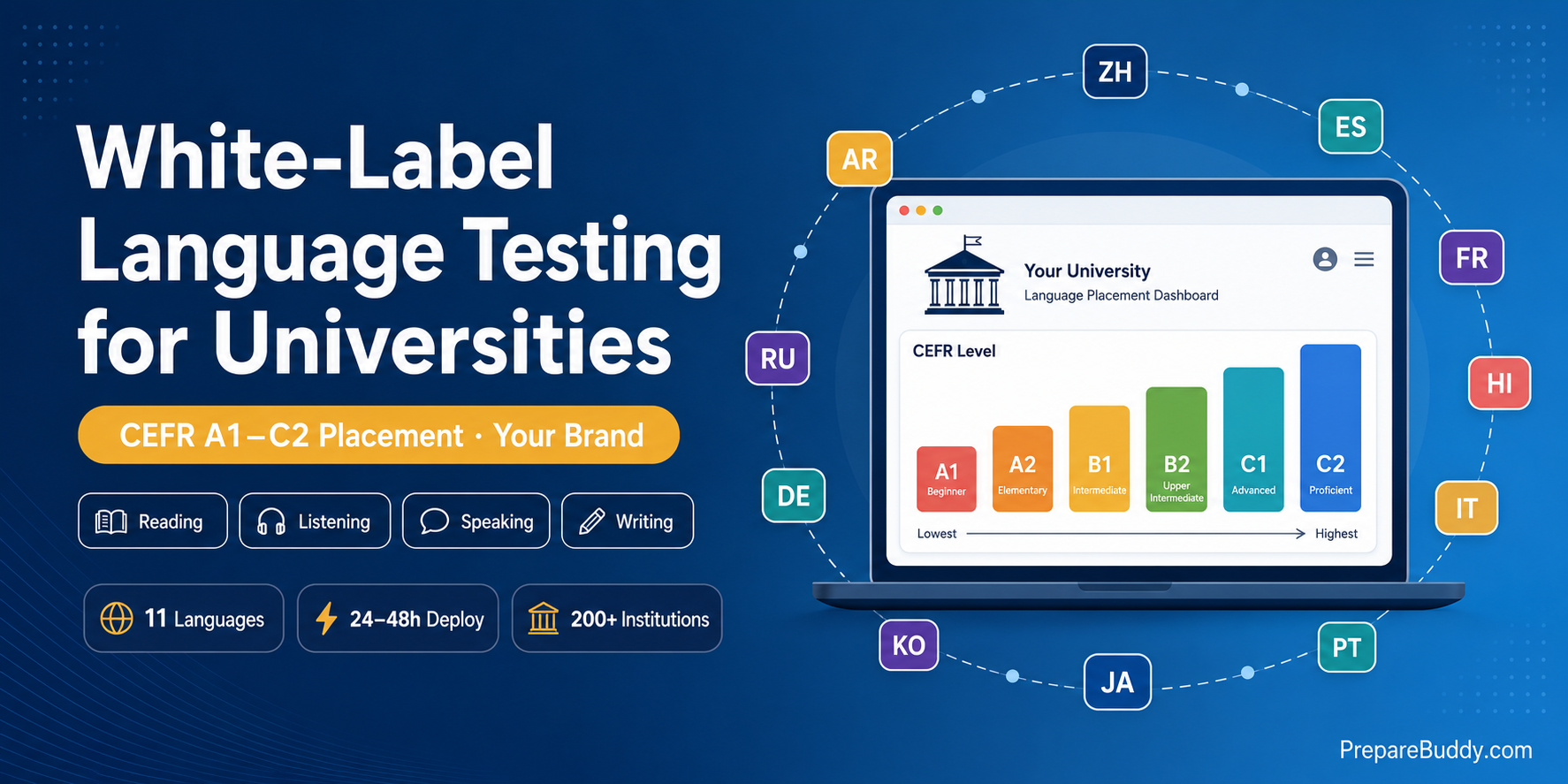
A European university confirms 380 exchange places in August. By the first week of term those students need to be streamed into French, Spanish, German and Mandarin course levels — and the language centre has four staff, six weeks, and a placement test that only exists on paper for two of those languages. This is the exact bottleneck white-label language testing was built for: an online CEFR placement engine that runs under the university's own brand, covers every language the institution teaches, and returns an A1–C2 level per student within minutes of them finishing.
This guide covers what a white-label CEFR testing platform actually gives a university, which 11 languages are supported, how genuine level detection differs from the placement tests most institutions run today, and what it takes to go live.
What white-label language testing means for a university
"White-label" is not a skin. On PrepareBuddy's university platform it means the assessment system runs on your domain, with your logo, your colour palette and branded email notifications — with zero PrepareBuddy branding visible to students or faculty. Students register, test, and receive results inside what looks and behaves like a university system, because for every practical purpose it is one.
The university keeps the brand and the student relationship. The platform supplies the item generation, the audio, the AI scoring and the reporting. Deployment takes 24–48 hours, and the platform is already used by 200+ institutions with 50,000+ students prepared.
The 11 languages you can test — and what students actually hear
Most placement systems test English and improvise everything else. The Adaptive Language Proficiency (ALP) engine runs the same framework — same question types, same scoring, same CEFR mapping — across 11 languages, each with language-specific text-to-speech. You can see the learner-facing side of this on the adaptive language testing page.
| Language | Script | Named TTS voices | Right-to-left |
|---|---|---|---|
| Chinese (Mandarin) | Simplified Han | 8 | No |
| Spanish | Latin | 3 | No |
| French | Latin | 1 | No |
| Hindi | Devanagari | 4 | No |
| Italian | Latin | 2 | No |
| Portuguese | Latin | 3 | No |
| Japanese | CJK | Auto-selected | No |
| Korean | Hangul | Auto-selected | No |
| German | Latin | Auto-selected | No |
| Russian | Cyrillic | Auto-selected | No |
| Arabic | Arabic | Auto-selected | Yes |
One detail matters more than it sounds: the entire test interface is localised, not just the content. Around 86 UI strings — task instructions, question-type labels, buttons, recording-status messages, confirmation dialogs — are maintained per language. A student sitting a German test sees German throughout, rather than the jarring English-instructions-on-a-German-test experience common to gamified engines. Arabic renders right-to-left properly. The one thing deliberately not translated is the student's own answer, because eliciting production in the target language is the whole point.
Placement that detects the level instead of guessing it
The standard university placement test asks an administrator to pick a level first, then measures the student against it. That works when you already know roughly where a cohort sits. For incoming exchange students with wildly mixed backgrounds, it does not.
ALP runs in two modes. In Targeted mode the operator picks a CEFR level and the test measures against it. In Placement mode the operator picks nothing: the generator produces content spread across all six CEFR bands — roughly 9 items per band, 54 in total — tags each item with its band, and the student's level is detected from how they perform across the full range.
Scoring is full-denominator, real-exam style: every question counts, and unanswered questions score zero. A student who answers half the test brilliantly cannot place high, because the blanks count against them — and the result page says so explicitly. That is deliberate. A placement is only meaningful when the whole range has been attempted.
The result maps an internal 0–100 score onto the Council of Europe's six-level scale:
| CEFR level | Score range | Descriptor |
|---|---|---|
| C2 | 85–100 | Mastery — understands virtually everything |
| C1 | 68–84 | Advanced — expresses ideas fluently and spontaneously |
| B2 | 51–67 | Upper intermediate — interacts with fluency |
| B1 | 34–50 | Intermediate — handles most everyday situations |
| A2 | 17–33 | Elementary — simple, routine tasks |
| A1 | 0–16 | Beginner — familiar everyday expressions |
Each student gets an overall CEFR level plus a per-skill breakdown — reading, listening, speaking and writing can each land on different bands — along with a comprehension-by-band diagnostic showing the highest difficulty they sustained. For a language centre building streams, the per-skill split is often the more useful number: the student who reads at C1 but speaks at B1 belongs in a different group than their headline level suggests.
Four skills, 18 question types
Placement tests that only measure reading are cheap to run and weak to defend. ALP covers all four skills with 18 purpose-built question types:
| Skill | Question types | Examples |
|---|---|---|
| Reading | 7 | Read & Select, Complete Word, Complete Sentences, Identify Main Idea, Title the Passage, Highlight Answer, Interactive Reading |
| Listening | 2 | Listen & Type, Interactive Listening |
| Speaking | 6 | Read Aloud, Listen & Speak, Speak About Photo, Read Then Speak, Interactive Speaking, Speaking Sample |
| Writing | 3 | Write About Photo, Interactive Writing, Writing Sample |
Speaking and writing responses come back with a multi-perspective feedback panel: an Examiner view citing specific CEFR descriptor gaps, a Study Coach view with one actionable fix and a before/after rewrite, and a Fellow Student view on score impact. Beyond the test itself, live voice conversation practice gives students roughly ten minutes of free-form conversation in the target language, scored on fluency, vocabulary, grammar and comprehension, with 48-emotion detection running throughout.
Where the time actually goes back to faculty
The business case for a university is rarely "better questions". It is staff hours and defensibility.
| Task | Manual process | White-label platform |
|---|---|---|
| Building a placement paper per language | Faculty author each version by hand | Generated from an admin selector — pick language, CEFR level and count |
| Speaking assessment | Scheduled one-to-one interviews | AI-scored, taken asynchronously |
| Marking and streaming | Days to weeks after test day | CEFR level and per-skill breakdown on submission |
| Languages covered | Whatever staff can author | All 11, one framework |
| Grading workload | Full faculty load | 75% time saved; 18+ hours returned weekly |
Institutions on the platform report 95% satisfaction, 95% AI scoring accuracy through multi-model verification, and 300% ROI within 18 months. The same infrastructure supports batch evaluation for coursework on the assessment side — see analytics and reporting for the cohort-level view.
How to get started
- Scope the languages and cohorts. Decide which of the 11 languages your centre places students in, and whether you need placement mode (unknown levels) or targeted mode (known cohort).
- Choose the test length. A quick diagnostic runs 10 minutes with 3–5 questions per section; the full diagnostic runs 20 minutes with 5–8. Full ALP tests run longer where a more detailed result is needed.
- Pre-generate the test pool. An administrator picks language, CEFR level and count from the dashboard; the queue builds the tests so students never wait on generation.
- Apply your branding. Domain, logo, colours, branded emails. Deployment runs 24–48 hours.
- Set access control. Language availability is managed through course enrolment and test-type permissions, so a Spanish-programme student sees only what you intend them to see.
- Run a pilot cohort. Test one intake group, compare the platform's placements against your existing streaming decisions, then scale.
The first month is free, no credit card is required, and there is no lock-in contract — which makes a single-language pilot on one intake a low-risk way to see whether the placements hold up against faculty judgement.
Is white-label language testing right for your institution?
It fits best where a university teaches several languages, runs recurring intakes, and needs placements that are consistent and reproducible across cohorts. It fits less well where a single language is taught to a small, stable cohort that faculty already know personally — there, a manual interview may genuinely be enough.
If you are evaluating options, the fastest way to judge quality is to sit the test yourself in a language you know well. Try the free CEFR test, or book a demo to see the branded university deployment and the admin dashboard.


Join the Discussion