

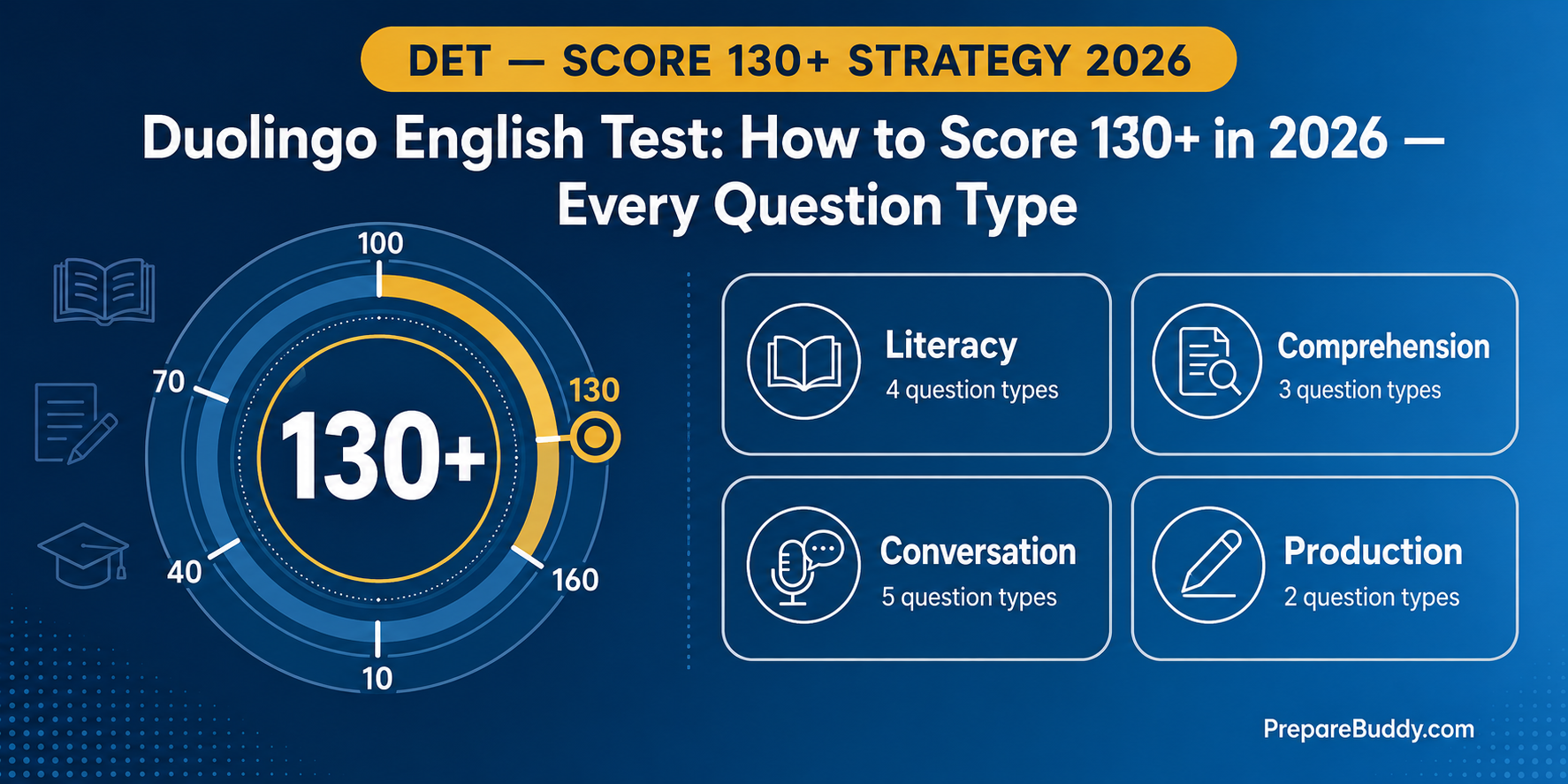
A 130 on the Duolingo English Test is the line where admissions officers stop reading scores and start reading essays. NYU, Columbia, UBC, Yale Master's programs and roughly 90% of the top-200 universities accept DET 120-125 as their minimum, but anything 130+ pushes you into the same comprehension band as IELTS 7.5 or TOEFL 100 — and into scholarship territory. The problem is that nothing inside the 60-minute test tells you how close you are. The score appears 48 hours later. By then it is too late to fix anything.
This guide is the playbook we wish every student had before their first DET attempt: section-by-section strategy, a question-type-by-question-type breakdown, the time targets that separate a 120 from a 135, and the AI-powered practice methods that actually move scores. Everything below is calibrated for the 2026 DET format.
Why 130+ Is the Real Target on the Duolingo English Test
The DET reports four sub-scores plus a single 10-160 overall score. Admissions teams almost never read the sub-scores in isolation — they look at the overall and at sub-score balance. Here is what 130+ buys you in practice:
| DET Overall | IELTS Equivalent | TOEFL iBT Equivalent | Typical University Acceptance |
|---|---|---|---|
| 105-110 | 6.0 | 72-79 | Community colleges, conditional admission |
| 115-120 | 6.5 | 83-90 | Most undergraduate programs |
| 125 | 7.0 | 93-99 | Top-200 universities, most graduate programs |
| 130 | 7.5 | 100-105 | Ivy-tier undergrad, competitive Master's, MBA prep |
| 140+ | 8.0+ | 110+ | Top scholarships, PhD funding shortlists |
Note one thing the table makes obvious: every 5 points on the DET maps to roughly half a band on IELTS. The cost of "winging it" is enormous. A student who walks in at 125-level prep and scores 122 has just lost access to dozens of programs. A student who walks in at 135-level prep and slips to 131 still hits 130+. The 130 target is the buffer.
The DET Format in 60 Minutes: What You Are Actually Being Tested On
The DET is adaptive. There are no section announcements like in the old paper tests — the test engine reshuffles question types based on how you are performing, and the difficulty rises as you answer correctly. The test measures four skills, scored on a 10-160 scale each, then averaged into the overall:
- Literacy — reading and writing combined
- Comprehension — reading and listening combined
- Conversation — listening and speaking combined
- Production — writing and speaking combined
That structure means a single question — say a "Read Aloud" — feeds both Comprehension and Conversation. You cannot prepare for one sub-score in isolation. To score 130+ overall, every sub-score must be 125+ and at least two must be 130+. Lopsided profiles get downgraded.
Time Targets That Separate 120 from 135
The DET does not show a per-question timer the way IELTS or TOEFL does, but the platform tracks every pause. Slow responses on speaking questions cost you fluency points; over-thinking on listening costs you accuracy because the audio is gone. Here are the targets advanced scorers hit:
| Question Type | Time Allowed | 130+ Scorer Pace | Common Mistake |
|---|---|---|---|
| Read and Select (vocabulary) | ~1 min | 30-40 sec | Over-checking once you've decided |
| Fill in the Blank (typed) | 3 min | 1.5-2 min | Spelling a guessed word |
| Read Aloud | 20 sec | Use all 20 sec, don't rush | Speaking too fast = lost intonation |
| Listen and Type | 3 plays max | Type after the 2nd play, verify on 3rd | Trying to type while listening |
| Write About the Photo | 60 sec | 50+ sec, 3-4 full sentences | Single-sentence answer caps your score |
| Speak About the Photo | 30 sec prep + 90 sec answer | Plan 3 points in 30 sec, use 80+ sec | Running out of things to say at 60 sec |
| Writing Sample | 5 min | 4 paragraphs, 180-220 words | Writing one block of text, no structure |
| Speaking Sample | 3 min | Speak for at least 2 min 30 sec | Stopping at 1 min 30 sec |
Question Type Playbook: How to Score 130+ on Each Task
1. Read and Select (Vocabulary Discrimination)
You see a screen of words and have to click only the real English words. This is the question type the DET engine uses to calibrate your level in the first 5 minutes, so accuracy here disproportionately raises every other question's difficulty. Score 130+ requires 98%+ accuracy. Three rules: (1) Never click a word you aren't sure of — false positives are penalized harder than misses. (2) Build vocabulary depth from word families: if you know "negotiate," recognise "negotiable," "negotiation," "negotiator." (3) The fake words often look Latinate ("interregnum" is real, "interrogate" is real, "interregalion" is fake). Read each one and ask: does it follow English morphology?
2. Read and Complete (Cloze Test)
A passage where you fill missing letters in roughly every fifth word. Score 130+ requires you to use context, not guess. Read the full sentence before the blank and the sentence after. The blank's grammar (verb tense, plural marker, preposition) is determined by the surrounding text. If a blank is "Th_y w_re ___ing the meeting," your verb tense and the "ing" cue both lock in that the answer involves a continuous verb.
3. Listen and Type (Dictation)
This is the highest-value question type on the entire test for boosting Comprehension. You hear a sentence up to three times, then type it exactly. 130+ scorers type 100% accurate sentences including punctuation. Strategy: Do not start typing during the first play. Just listen. Plays 2 and 3 are for typing. Punctuation matters — listen for sentence-final intonation (the drop on "today.") and add the period. Capitalize proper nouns; the test catches missing capitals.
4. Read Aloud
You read a sentence aloud into your microphone. The DET scores three things: intelligibility, fluency, and prosody (intonation pattern). 130+ scorers do not race through the sentence. They use the full 20 seconds, slow down on content words (nouns, verbs), and let function words (the, of, is) reduce naturally. Practise reading newspaper headlines aloud with the rhythm: STRESS-unstressed-STRESS-unstressed. Avoid the two killers: monotone delivery and adding "uh" or "um" while reading.
5. Write About the Photo
You see an image and have 60 seconds to write a description. 130+ answers are three to four full sentences, not bullet points or single-sentence answers. Structure that works on every photo: (1) one sentence describing the main subject, (2) one sentence describing what is happening or being done, (3) one sentence about the setting/context, (4) optional one sentence speculating about the situation or making an inference. Use a mix of present continuous ("a woman is holding") and present simple ("the office appears modern"). Avoid spelling errors — the auto-grader penalises them.
6. Speak About the Photo
The same image, but 30 seconds to plan and 90 seconds to speak. 130+ scorers do not waste planning time on what to say first — they plan three points: subject, action, inference. Then they speak in connected paragraphs, not list form. Use signpost words ("In this photo I can see...", "What's interesting is that...", "This makes me think..."). Keep talking for at least 80 seconds. Silence is the single biggest score-killer here.
7. Listen and Speak (Interactive Listening)
You hear a question or a short scenario and respond verbally. The model wants spontaneity, not a memorised speech. The way to score 130+ is to directly answer the question first in one sentence, then expand with one supporting example, then close with a personal opinion or extension. The full answer should be 30-50 seconds. Avoid one-line answers ("Yes I agree") and avoid wandering off-topic.
8. The Writing Sample (5 minutes)
You write a longer essay-style response to a prompt. This is the highest-weighted Production task and the single biggest driver of your Writing score. Structure for 130+:
- Sentence 1: State your position directly. No throat-clearing.
- Paragraph 1 (3-4 sentences): Your first supporting reason with one specific example.
- Paragraph 2 (3-4 sentences): Your second supporting reason. Use a connector to open ("Furthermore," "Beyond that,").
- Closing (2 sentences): Restate position + a forward-looking thought.
Target 180-220 words. Use varied sentence structures — a mix of short punchy sentences and one complex sentence per paragraph. Use 4-5 advanced connectors (consequently, notwithstanding, in light of, given that). And spell-check before time runs out.
9. The Speaking Sample (3 minutes)
The closing task. You record a 3-minute monologue answering an open-ended prompt. The 130+ formula: introduction (15 sec) → two main points with examples (45 sec each) → personal experience (30 sec) → conclusion (15 sec) → keep talking until time runs out. Many students stop at 90 seconds because they "ran out of things to say." Don't. Keep going. The grader rewards continuous fluent speech; stopping early signals you have hit your fluency ceiling.
The 6-Week Study Plan for 130+
| Week | Focus | Daily Time | Key Outcome |
|---|---|---|---|
| 1 | Diagnostic + vocabulary baseline | 60 min | Identify your weakest sub-score |
| 2 | Listen and Type + Read and Complete | 75 min | Comprehension to 125+ in practice |
| 3 | Read Aloud + Speak About Photo | 75 min | Conversation to 125+ in practice |
| 4 | Writing Sample + Speaking Sample | 90 min | Production to 130+ in practice |
| 5 | Full mock tests, every other day | 90 min | Three full mocks averaging 128+ |
| 6 | Mock + targeted weak-area drill | 60 min | Final mock 130+ |
How PrepareBuddy Helps You Hit 130+
The DET is unforgiving because feedback comes 48 hours after you finish. PrepareBuddy's Duolingo English Test prep module closes that loop. The platform delivers AI-scored mocks with 95% accuracy alignment with official human raters, so the practice score you see is the score you can expect on test day. Every question type listed above has dedicated drill banks with adaptive difficulty calibration.
The speaking question types — Read Aloud, Speak About the Photo, Speaking Sample — run through PrepareBuddy's Voice AI engine, which evaluates pronunciation, fluency, intonation and pacing in real time. The platform supports 30+ English accents and 48-emotion detection, so a student with an Indian, Filipino, Nigerian or Latin American accent gets the same accuracy band as a North American test-taker. Writing tasks run through the same AI Assessment engine universities use for batch grading, with rubric-aligned feedback explaining exactly why you lost points.
Want to test where you stand right now? Take a free DET-style diagnostic at preparebuddy.com/language-tests/free-test and the system will return a score estimate plus a question-by-question breakdown of your weak areas — the same diagnostic 200+ institutions use to place new students into the right prep track.
The Three Habits Every 130+ Scorer Has
- They practice under timed conditions every session. No untimed drills. The DET is a speed-and-accuracy test; untimed practice does not transfer.
- They review wrong answers, not just count them. Every missed Listen and Type, every Read Aloud rated below 80, every Write About Photo flagged for spelling — they read the feedback and re-attempt the same question type immediately.
- They take three full mock tests in the final week before exam day. Not five. Not ten. Three full mocks, spaced 48 hours apart, with full review between each. This is what stabilises a 128 into a confident 130+.
Frequently Asked Questions
Is 130 hard to score on the Duolingo English Test?
130 is competitive but achievable for a serious test-taker. It corresponds to roughly IELTS 7.5 and TOEFL 100 — solid upper-intermediate English. Most students who follow a structured 6-week plan with daily timed practice can reach 130+. Without structured practice, the median student plateaus around 115-120.
How many times can I take the Duolingo English Test?
You can take the DET up to 3 times in a 30-day window. Each attempt is $59 USD. The 130+ target makes this important: a single rushed attempt without preparation often forces students into a second paid attempt within the month.
Do universities accept the Duolingo English Test in 2026?
Yes. Over 5,500 institutions accept the DET as of 2026, including most of the Ivy League, Russell Group, Group of Eight (Australia), and U15 (Canada) universities. Always confirm the minimum score for your specific program — 120 is the common floor, but 130+ is what scholarship and graduate committees actually read.
How long should I prepare for the DET to score 130+?
4-6 weeks of structured daily practice (60-90 minutes) is the typical timeline for students starting around the 110-115 level. Students starting below 100 should plan 8-10 weeks to safely reach 130.
Can AI grading on practice tests match my real DET score?
The best AI graders today, including PrepareBuddy's multi-model verification engine, hit 95% alignment with human raters. The 5% gap is usually accent-related on speaking tasks or edge-case grammar judgements on writing. Use AI scores as a directional benchmark and trust the 5-point band around them.
Start Practising Today
The 60 minutes of the DET will not feel like 60 minutes. The adaptive engine will push question difficulty as you go, and your decision-making speed under that pressure is what either holds you at 122 or pushes you past 130. The students who score 130+ are the ones who walked into the test having seen every question type, in every difficulty band, under timed conditions, dozens of times.
Take a free DET-style diagnostic test on PrepareBuddy now to see where you stand, or schedule a demo if you run a coaching centre and want to offer your students a full DET preparation track without building it from scratch.


Join the Discussion