

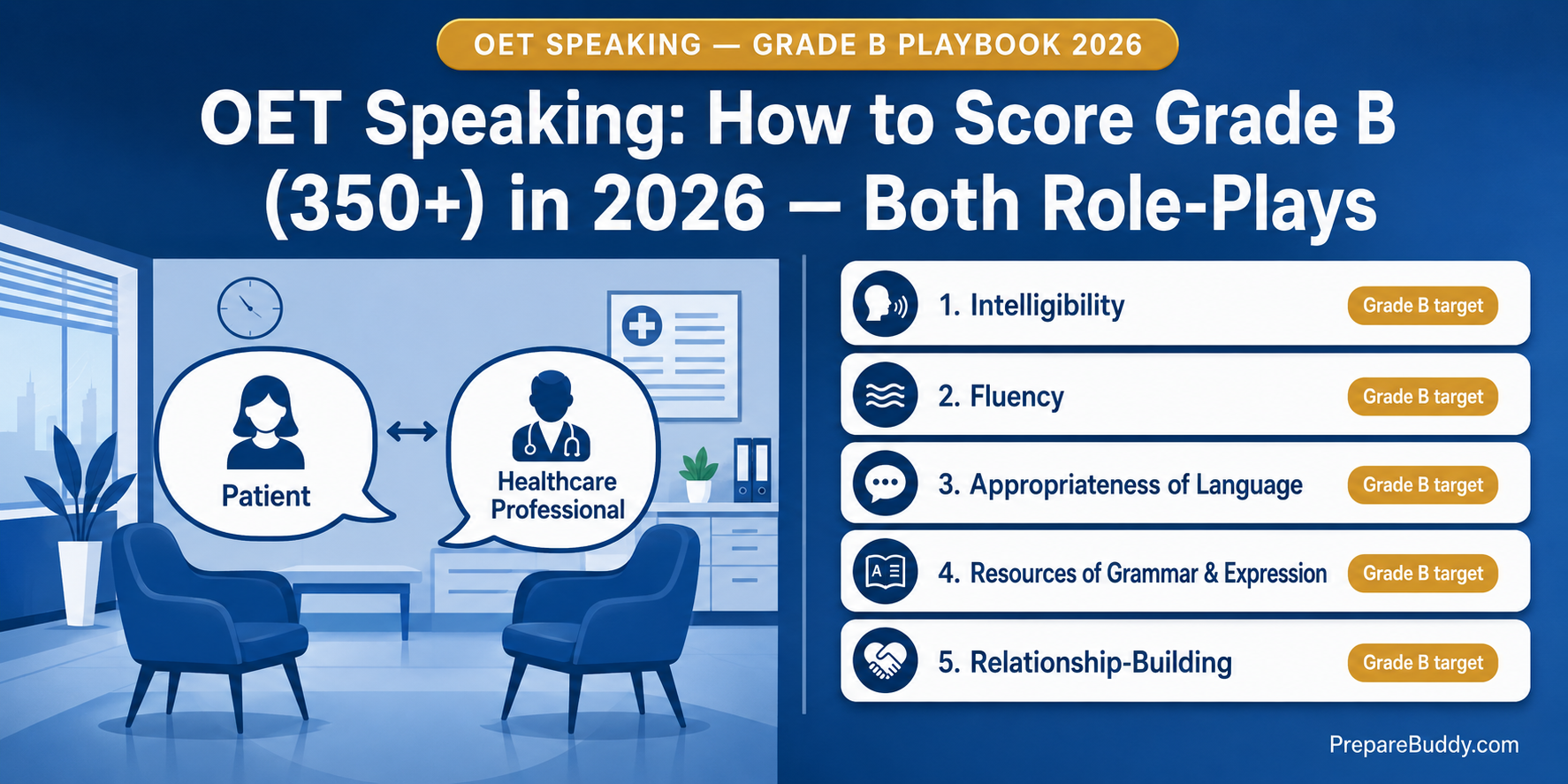
If you need to register as a nurse, doctor, pharmacist, or other healthcare professional in Australia, the UK, Ireland, New Zealand, Singapore, Dubai, or Namibia, the regulator almost certainly wants the same OET result: Grade B (350+) in every subtest — and Speaking is where the largest number of qualified clinicians get stuck. The exam isn’t testing whether you can speak English. It’s testing whether you can do clinical communication in English: build rapport, take a history, explain a plan, manage anxiety, and structure information under time pressure. This guide breaks down both role-plays, all nine scoring criteria, and a four-week practice plan that targets the exact behaviours OET assessors mark up.
OET Speaking at a Glance
OET Speaking is identical in format for nurses, doctors, dentists, pharmacists, physiotherapists, occupational therapists, optometrists, podiatrists, radiographers, speech pathologists, dieticians, and veterinary practitioners — only the role-play scenarios change to match your profession.
| Element | Detail |
|---|---|
| Total duration | About 20 minutes (including warm-up) |
| Format | 2 profession-specific role-plays with an interlocutor playing the patient/parent/carer |
| Preparation time per role-play | 3 minutes to read the cue card and plan |
| Length of each role-play | About 5 minutes |
| Score scale | 0–500 per subtest |
| Grade B threshold | 350+ (the common registration cut-off) |
| Grade A threshold | 450+ |
| Number of scored criteria | 9 (4 linguistic + 5 clinical communication) |
What Grade B Actually Means in Numbers
OET converts a raw score on each criterion into a band that lands you in one of five grade buckets. Most candidates aren’t aiming for Grade A; they’re aiming to clear 350 cleanly in every subtest. Knowing the grade table tells you how much margin you have.
| OET Speaking Score | Grade | What it typically signals |
|---|---|---|
| 450–500 | A | Native-speaker-level clinical communication |
| 350–440 | B | Registration-ready for most healthcare regulators |
| 300–340 | C+ | Strong English, gaps in clinical structure or empathy markers |
| 200–290 | C | Intelligible but inconsistent rapport-building and structure |
| 100–190 | D | Significant pronunciation/grammar/structure issues |
The 9 Criteria OET Speaking Assessors Mark
This is the single most useful piece of information in OET Speaking prep. Each role-play is scored on these 9 criteria. Four are linguistic; five are clinical communication. Most candidates over-prepare the linguistic side and under-prepare the clinical side. Grade B candidates close that gap.
Linguistic Criteria
- Intelligibility — pronunciation, stress, intonation, rhythm. Can the patient understand you on first hearing?
- Fluency — smooth, connected speech without long unnatural pauses.
- Appropriateness of language — correct register, lay terms for the patient, polite firmness.
- Resources of grammar and expression — range, accuracy, and flexibility of structures.
Clinical Communication Criteria
- Relationship building — greeting, acknowledging the patient, showing empathy with specific phrases.
- Understanding and incorporating the patient’s perspective — eliciting ideas, concerns, expectations and responding to them.
- Providing structure — signposting, sequencing, summarising before transitions.
- Information-gathering — open then closed questions, clarification, screening.
- Information-giving — chunking, checking understanding, avoiding jargon.
Role-Play 1: Master the First 90 Seconds
The first 90 seconds of each role-play decide your relationship-building and structure marks. If you skip the greeting, jump straight to the medical question, and never check on the patient’s emotional state, you’ve already lost two clinical criteria before you’ve had a chance to demonstrate the others.
Use this opening template every single role-play in your practice, then make it automatic:
- Greet by name — “Hello, my name is [your name], I’m one of the nurses on the ward today. Is it okay if I call you [patient’s first name]?”
- Acknowledge the context — “I understand you’ve been waiting / your son was admitted last night / you’ve had this pain for a few days.”
- Signpost what’s about to happen — “I’d like to ask you a few questions about [topic], then we can discuss what happens next. Does that sound alright?”
- Elicit perspective early — “Before we start, is there anything specific you’re worried about?”
This 30-second routine touches relationship building, structure, and patient perspective — three clinical criteria — before you say anything content-specific.
Role-Play 2: Information-Giving Without Jargon
Role-play 2 is usually the harder one for Grade B candidates because it shifts the load from gathering to giving. You’ll be explaining a diagnosis, a procedure, a medication regimen, lifestyle changes, or a referral. The traps are jargon, information dumping, and forgetting to check understanding.
Use the chunk-and-check rhythm: one idea, one plain-English explanation, one check.
- Chunk: “The medication we’d like to start you on is called metformin.”
- Translate: “It helps your body use insulin more effectively, which keeps your blood sugar in a safer range.”
- Check: “Does that make sense so far, or would you like me to go over anything again?”
Repeat that rhythm three to five times across the role-play and you’ll cover Information-giving, Appropriateness of language, and Patient perspective in one move.
Top 7 Mistakes That Keep Candidates at 320
- Skipping the greeting and signposting because of nerves.
- Using medical jargon (“hypertension”, “NPO”, “PRN”) without translating it.
- Ignoring the patient’s emotional cues (“I’m really scared”) and replying with content instead of empathy.
- Reading directly off the prep card during the role-play.
- Speaking in long, unstructured monologues without checking understanding.
- Closed-ended question stacking: “Do you have pain? Is it sharp? Is it constant?” instead of one good open question.
- Running out of time on role-play 2 and not closing properly.
4-Week OET Speaking Plan for Grade B
| Week | Focus | Daily Practice (45–60 min) |
|---|---|---|
| Week 1 | Criteria fluency | Memorise the 9 criteria. Record yourself doing 1 opening per day. Self-grade against the criteria. |
| Week 2 | Role-play 1 patterns | 2 full role-plays per day with focus on information-gathering and patient perspective. Build a phrase bank. |
| Week 3 | Role-play 2 patterns | 2 full role-plays per day with focus on chunk-and-check and lay-term explanations. Time strictly to 5 minutes. |
| Week 4 | Full mocks under exam conditions | 1 full Speaking simulation per day with both role-plays back-to-back. Review every recording against the 9 criteria. |
Why AI Speaking Practice Closes the OET Feedback Gap
OET Speaking has one specific bottleneck most candidates run into: there’s no easy way to do an honest, daily, profession-specific role-play with feedback. Human tutors are expensive and slow to schedule. Practice partners can’t score you. Recording yourself helps but you can’t hear your own pronunciation problems.
The PrepareBuddy Voice AI handles this. It supports 30+ English accents, detects 48 different emotional cues in your speech, and scores pronunciation, fluency, and clinical-communication signposting in real time — so every role-play comes back with a per-criterion breakdown the same way an OET assessor would mark it. PrepareBuddy’s AI scoring runs at 95% accuracy with multi-model verification, which is why over 200 institutions use it to grade speaking submissions at scale. For OET candidates specifically, the OET module ships profession-specific role-play banks for nurses, doctors, dentists, pharmacists, and physiotherapists, and the AI Tutor remembers each session so it can point out the same mistake until you stop making it. AI study plans sequence your four weeks automatically based on which criteria are pulling your score down.
Frequently Asked Questions
What is the minimum OET Speaking score for nursing registration?
Most major regulators (AHPRA in Australia, NMC in the UK, NMBI in Ireland) accept Grade B, which means 350+ in each of the four subtests including Speaking. A handful of US and Canadian boards accept Grade C+ (300+) but this is the exception.
How long should I prepare for OET Speaking to hit Grade B?
If your current speaking level is around CEFR B2, plan on 4–6 weeks of focused daily practice. Lower starting levels typically need 8–12 weeks. The bottleneck is rarely English — it’s converting clinical workflow into structured, patient-perspective communication.
Do the OET Speaking role-plays differ for nurses and doctors?
The structure (2 role-plays, 5 minutes each, 3 minutes prep) is identical. The scenarios are written for your profession, so a nurse will get nursing scenarios (wound care, post-op observation, medication administration) and a doctor will get doctor scenarios (history-taking, diagnosis explanation, management plans).
Can I score Grade B with strong accents?
Yes. OET assessors are trained to grade intelligibility, not accent. As long as a first-time listener can follow you on a single hearing, accent itself isn’t penalised. What hurts intelligibility scores is unclear word stress, swallowed endings, and inconsistent intonation — all fixable with targeted practice.
Is one OET Speaking mock test per week enough?
For Grade B candidates, no. Aim for at least one full role-play every day in the final 2 weeks, and one back-to-back two-role-play simulation every other day in the final week. Volume of feedback — not hours studied — predicts score gains.
Take Your OET Speaking Practice from Guesswork to Grade B
OET Speaking rewards a very specific behaviour: structured, empathetic, jargon-free clinical communication delivered fluently under time pressure. The candidates who clear Grade B aren’t the ones with the strongest English — they’re the ones who practise the nine criteria daily and get honest feedback after every role-play.
Run a free PrepareBuddy diagnostic to see exactly which of the nine criteria are pulling your score below 350, then let the platform sequence your four-week plan around them. Start a free OET Speaking practice round here, or schedule a demo if you’re a coaching centre or healthcare-English program looking to add an AI-powered OET track.


Join the Discussion