

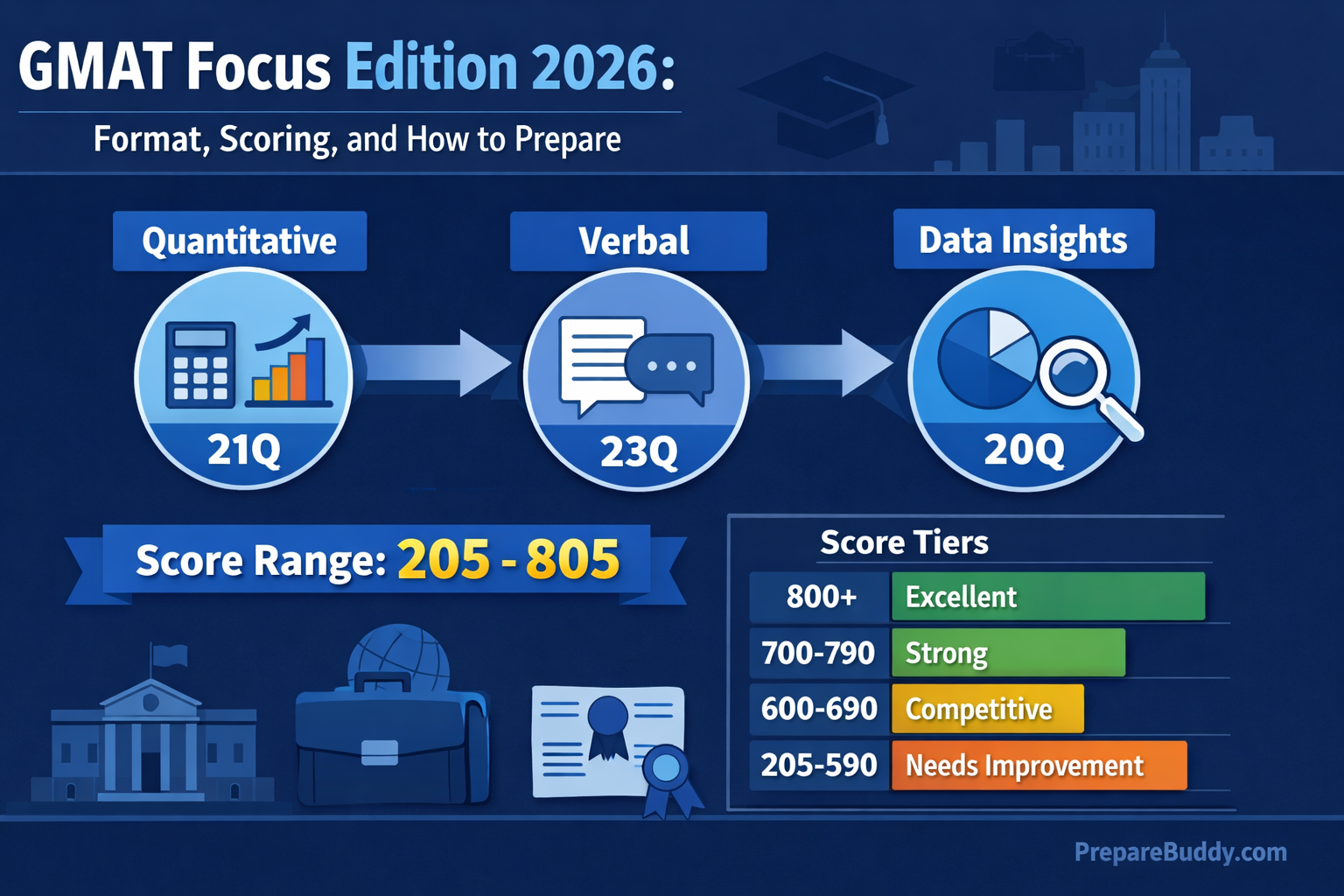
The GMAT Focus Edition replaced the classic GMAT in early 2024, and it has fundamentally changed how MBA applicants approach business school admissions testing. If you are planning to apply to top MBA programs in 2026, here is exactly what the new format looks like, how scoring works, and how to build an effective preparation strategy.
What Changed: Classic GMAT vs GMAT Focus Edition
The GMAT Focus Edition is shorter, more flexible, and eliminates some of the most dreaded sections from the classic test. Here is how the two formats compare:
| Feature | Classic GMAT | GMAT Focus Edition |
|---|---|---|
| Total Duration | 3.5 hours | 2 hours 15 minutes |
| Number of Sections | 4 | 3 |
| Score Range | 200-800 | 205-805 |
| Analytical Writing | Yes (AWA essay) | Removed |
| Integrated Reasoning | Separate section | Merged into Data Insights |
| Section Order | Fixed | You choose the order |
| Score Preview | After completion | Before sending to schools |
| Question Review | Not available | Bookmark and review within section |
The biggest relief for most test-takers: the essay section is gone. The GMAT Focus Edition is a purely multiple-choice and data-analysis test, cutting nearly 75 minutes off total test time.
The Three Sections of GMAT Focus Edition
Each section is 45 minutes long, giving you a total testing time of 2 hours 15 minutes including breaks.
1. Quantitative Reasoning (21 Questions, 45 Minutes)
This section tests problem-solving skills using arithmetic, algebra, geometry, and word problems. Unlike the classic GMAT, Data Sufficiency questions have moved to the Data Insights section, so Quantitative Reasoning is now purely problem-solving.
Key topics include algebra, arithmetic, number properties, geometry, and rate/work problems. You will not need advanced math. The difficulty comes from time pressure and problem design, not complex formulas.
2. Verbal Reasoning (23 Questions, 45 Minutes)
Verbal Reasoning focuses on two question types: Reading Comprehension and Critical Reasoning. Sentence Correction has been removed from the GMAT Focus Edition.
Reading Comprehension passages cover business, science, and social science topics. Critical Reasoning questions test your ability to evaluate arguments, including strengthening, weakening, and identifying assumptions.
3. Data Insights (20 Questions, 45 Minutes)
This is the newest section, combining elements from the old Integrated Reasoning section with Data Sufficiency questions. You will encounter five question types:
| Question Type | What It Tests | Tip |
|---|---|---|
| Data Sufficiency | Whether given data is enough to solve a problem | Focus on sufficiency, not solving |
| Multi-Source Reasoning | Synthesizing information from multiple tabs/sources | Read all sources before answering |
| Table Analysis | Interpreting sortable data tables | Sort by relevant columns first |
| Graphics Interpretation | Reading graphs and visual data | Identify axis labels and scale carefully |
| Two-Part Analysis | Solving connected two-variable problems | Check that both parts satisfy constraints |
GMAT Focus Edition Scoring: How It Works
The total score range is 205 to 805, in 10-point increments. Each section contributes equally to your total score, with individual section scores ranging from 60 to 90.
| Score Range | Percentile (Approximate) | Competitiveness |
|---|---|---|
| 735-805 | 99th+ | Top 1% - elite programs (HBS, Stanford GSB, Wharton) |
| 695-725 | 90th-98th | Highly competitive for T15 MBA programs |
| 655-685 | 75th-89th | Competitive for T25 programs |
| 615-645 | 55th-74th | Average range - good for many programs |
| 555-605 | 25th-54th | Below average - may need strong profile elsewhere |
| Below 555 | Below 25th | Consider retaking or alternative tests |
One major advantage: you get to preview your score before deciding whether to send it to schools. This means you can retake the test without business schools seeing a lower score.
How to Prepare for the GMAT Focus Edition
Preparation strategies have shifted with the new format. Here is a structured approach that works for most test-takers aiming for 700+.
Phase 1: Diagnostic Assessment (Week 1)
Start with a full-length practice test to establish your baseline. Identify which of the three sections needs the most work. Many students find Data Insights the most challenging because it combines quantitative logic with data interpretation in unfamiliar formats.
PrepareBuddy offers a free diagnostic test with AI-scored results and section-by-section analysis, so you know exactly where to focus from day one.
Phase 2: Section-by-Section Practice (Weeks 2-6)
Dedicate focused study blocks to each section:
| Section | Focus Areas | Weekly Time |
|---|---|---|
| Quantitative | Word problems, algebra, number properties | 6-8 hours |
| Verbal | Critical Reasoning arguments, RC main idea and inference | 5-7 hours |
| Data Insights | Data Sufficiency logic, table sorting, graph reading | 5-7 hours |
The key is practicing with content that matches the actual GMAT Focus format. PrepareBuddy offers a GMAT preparation platform that generates unlimited practice questions calibrated to the 2024-2026 GMAT Focus specifications, with AI-powered scoring that explains exactly why each answer is correct or incorrect.
Phase 3: Timed Full-Length Tests (Weeks 7-8)
Take at least 3-4 full-length practice tests under timed conditions. Experiment with different section orders to find your optimal sequence. Many test-takers prefer starting with their strongest section to build confidence.
Phase 4: Review and Test Day (Week 8+)
Review every mistake from your practice tests. Focus on understanding the reasoning behind correct answers, not just memorizing solutions. On test day, remember that you can bookmark questions and return to them within each section. Use this feature strategically.
GMAT Focus Edition vs GRE: Which Should You Take?
Most top MBA programs accept both the GMAT and GRE. Here is a quick comparison to help you decide:
| Factor | GMAT Focus | GRE |
|---|---|---|
| Duration | 2 hr 15 min | About 3 hr 10 min |
| Math Level | Moderate (no calculus) | Moderate (no calculus) |
| Vocabulary | Minimal | Heavy vocabulary required |
| Accepted By | Business schools primarily | Business + other graduate programs |
| Data Interpretation | Dedicated section | Mixed into Quant |
| Score Preview | Yes, before sending | Yes, before sending |
| Cost | $275 | $220 |
Choose the GMAT Focus if you are applying exclusively to business schools and prefer a shorter test. Choose the GRE if you are also considering non-business graduate programs or if vocabulary-heavy verbal sections are a concern.
Key Takeaways
The GMAT Focus Edition is a more streamlined, test-taker-friendly exam than its predecessor. With no essay section, flexible section ordering, and score preview, you have more control over your test experience than ever before. The score range of 205-805 and the new Data Insights section are the biggest changes to understand.
The most effective preparation combines diagnostic assessment, targeted section practice, and full-length timed tests. With the right study plan and practice materials, a 700+ score is achievable for most dedicated test-takers within 8-10 weeks of focused preparation.
Ready to start preparing? Take a free GMAT Focus practice test on PrepareBuddy to get your baseline score and a personalized study plan powered by AI.


Join the Discussion