

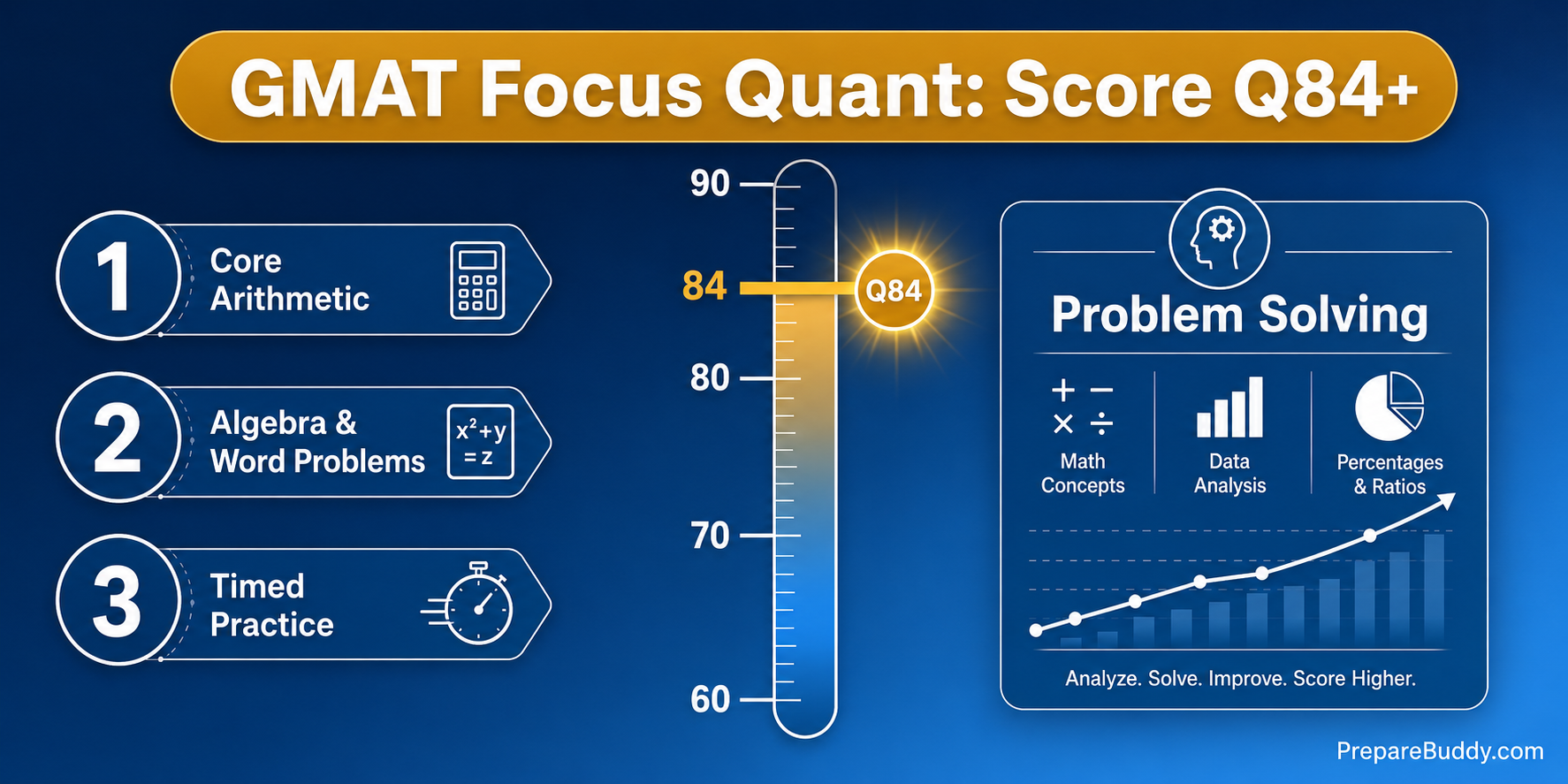
You have 45 minutes to answer 21 questions on the GMAT Focus Quantitative Reasoning section. That works out to roughly 2 minutes and 8 seconds per question, with no calculator, no geometry to fall back on, and an algorithm that gets harder every time you answer correctly. Most candidates do not run out of math ability on this section. They run out of time.
If you are targeting a top business school, your GMAT Focus Quantitative Reasoning score is one of the first numbers an admissions committee looks at. This guide breaks down exactly what the section tests in 2026, how the adaptive scoring works, which topics deserve your practice hours, and the pacing discipline that separates a Q84 from a Q78.
What the GMAT Focus Quantitative Reasoning Section Tests
The GMAT Focus Edition stripped the Quant section down to its essentials. Data Sufficiency moved out (it now lives in the Data Insights section), and geometry was removed entirely. What remains is pure Problem Solving across two content domains: arithmetic and algebra.
| Attribute | GMAT Focus Quantitative Reasoning |
|---|---|
| Number of questions | 21 |
| Time allowed | 45 minutes |
| Average time per question | ~2 minutes 8 seconds |
| Question format | Problem Solving (multiple choice, 5 options) only |
| Content domains | Arithmetic and Algebra (no geometry) |
| Data Sufficiency | Removed from Quant (now in Data Insights) |
| Calculator | Not allowed |
| Section score range | 60-90 (1-point increments) |
| Question review & edit | Up to 3 answers can be changed at section end |
Two features make this section deceptively tough. First, it is computer-adaptive: answer correctly and the next question gets harder; answer incorrectly and it gets easier. Your score reflects the difficulty level you sustain, not just the raw count of right answers. Second, the Focus Edition lets you bookmark questions and edit up to three answers before the section ends. Used well, that review feature is a safety net. Used badly, it is a time sink.
How GMAT Focus Quant Scoring Works
Each section of the GMAT Focus Edition is scored from 60 to 90, and those three section scores combine into a total score from 205 to 805. Because the algorithm rewards sustained difficulty, a handful of early careless errors can cap your ceiling for the rest of the section. Here is roughly how Quant section scores map to outcomes:
| Quant Score | Approx. Percentile Band | What It Signals |
|---|---|---|
| 88-90 | Top tier | Elite quant profile; clears the bar at every M7 program |
| 84-87 | High | Competitive for top-15 MBA programs |
| 80-83 | Above average | Solid; pair with a strong Verbal and Data Insights score |
| 75-79 | Mid | Acceptable for many programs; may need offsetting strengths |
| Below 75 | Lower | Worth a retake if quant-heavy programs are the goal |
Percentile bands shift slightly each year as the test-taker pool changes, so treat the table as directional. The takeaway is constant: on an adaptive test, consistency beats heroics. Protecting your accuracy on the early and middle questions matters more than nailing the single hardest item.
The Two Content Domains: Where to Spend Your Practice Hours
With geometry gone, the GMAT Focus Quant section concentrates almost entirely on arithmetic and algebra. That narrowing is good news: you can master a finite, well-defined set of concepts. Here is how to prioritise.
| Domain | Core Topics | Why It Matters |
|---|---|---|
| Arithmetic | Number properties, fractions, ratios, percentages, rates, statistics (mean/median), probability, combinatorics | The largest share of questions; ratio and percentage logic appears everywhere |
| Algebra | Linear & quadratic equations, inequalities, exponents and roots, functions, word-problem translation | Translating words into equations quickly is the single biggest time-saver |
The skill that pays off most is not any single topic. It is translation speed: reading a word problem and converting it into a clean equation or ratio in under 30 seconds. Candidates who stall here lose two or three minutes per question and never recover their pacing.
Pacing: The Real GMAT Quant Killer
Forty-five minutes for 21 questions leaves no room for a single long detour. The discipline is simple to state and hard to practice: if a question is going to take more than three minutes, make your best guess, flag it, and move on. Use these checkpoints to stay on track.
| Checkpoint | Questions Completed | Time Remaining (of 45 min) |
|---|---|---|
| Quarter | ~5 | ~34 minutes |
| Halfway | ~11 | ~22 minutes |
| Three-quarter | ~16 | ~11 minutes |
| Finish line | 21 | 0 (leave time to use up to 3 edits) |
Leaving a question unanswered is heavily penalised on the GMAT, so never let the clock run out with blank items. If you have 90 seconds and three questions left, guess all three rather than perfecting one.
A 6-Week GMAT Quant Study Framework
- Weeks 1-2 - Rebuild the fundamentals. Drill number properties, fractions, ratios, and percentages until they are automatic. Mental-math fluency replaces the calculator you will not have.
- Weeks 3-4 - Algebra and word problems. Practice translating word problems into equations against a 30-second target. Cover inequalities, exponents, and functions.
- Week 5 - Mixed adaptive sets under time. Stop practicing by topic. Do mixed 21-question sets in 45 minutes so your brain learns to switch contexts and pace itself.
- Week 6 - Full adaptive mocks and error review. Take full-length adaptive mocks, then spend as much time reviewing your errors as taking the test. Every wrong answer is a pattern to fix.
The most underrated habit on this list is error review. A logged, categorised error (careless arithmetic vs. concept gap vs. timing pressure) tells you exactly what to fix next. Students who only chase volume plateau; students who analyse their mistakes keep climbing.
How PrepareBuddy Helps You Train for GMAT Focus Quant
The hard part of self-study is getting realistic, adaptive practice with feedback you can trust. PrepareBuddy was built to solve exactly that. Its adaptive testing engine mirrors the GMAT's real-time difficulty adjustment, so your practice score reflects the difficulty you can actually sustain rather than a flat question set.
Behind the questions is a multi-model AI architecture. A 120B-parameter model generates GMAT-style quantitative items that testing showed are 96% indistinguishable from official questions. Crucially for math, every generated quantitative question is independently re-solved by a dedicated math-verification model (benchmarked at 81.4% on AIME 2024) in a two-pass check that catches and fixes answer-key mismatches before a question ever reaches you. That is why our AI scoring holds 95% accuracy. When you get a question wrong, the AI tutor is available 24/7 to walk you through the correct method, and it remembers your weak areas across sessions.
Your analytics dashboard turns every practice set into an error map, separating careless mistakes from genuine concept gaps, while AI study plans rebuild your weekly schedule around the topics costing you the most points. More than 50,000 students have prepared on the platform across IELTS, PTE, TOEFL, GRE, GMAT, SAT and more.
Start Practicing GMAT Quant the Smart Way
Mastering the GMAT Focus Quantitative Reasoning section comes down to two things: airtight fundamentals in arithmetic and algebra, and the pacing discipline to keep 21 questions inside 45 minutes. Adaptive practice with trustworthy feedback gets you there faster than any textbook. Sign up for PrepareBuddy (first month free, no credit card required) to start adaptive GMAT practice with AI feedback, or schedule a demo to see the platform in action. Compare options on our pricing page.


Join the Discussion