

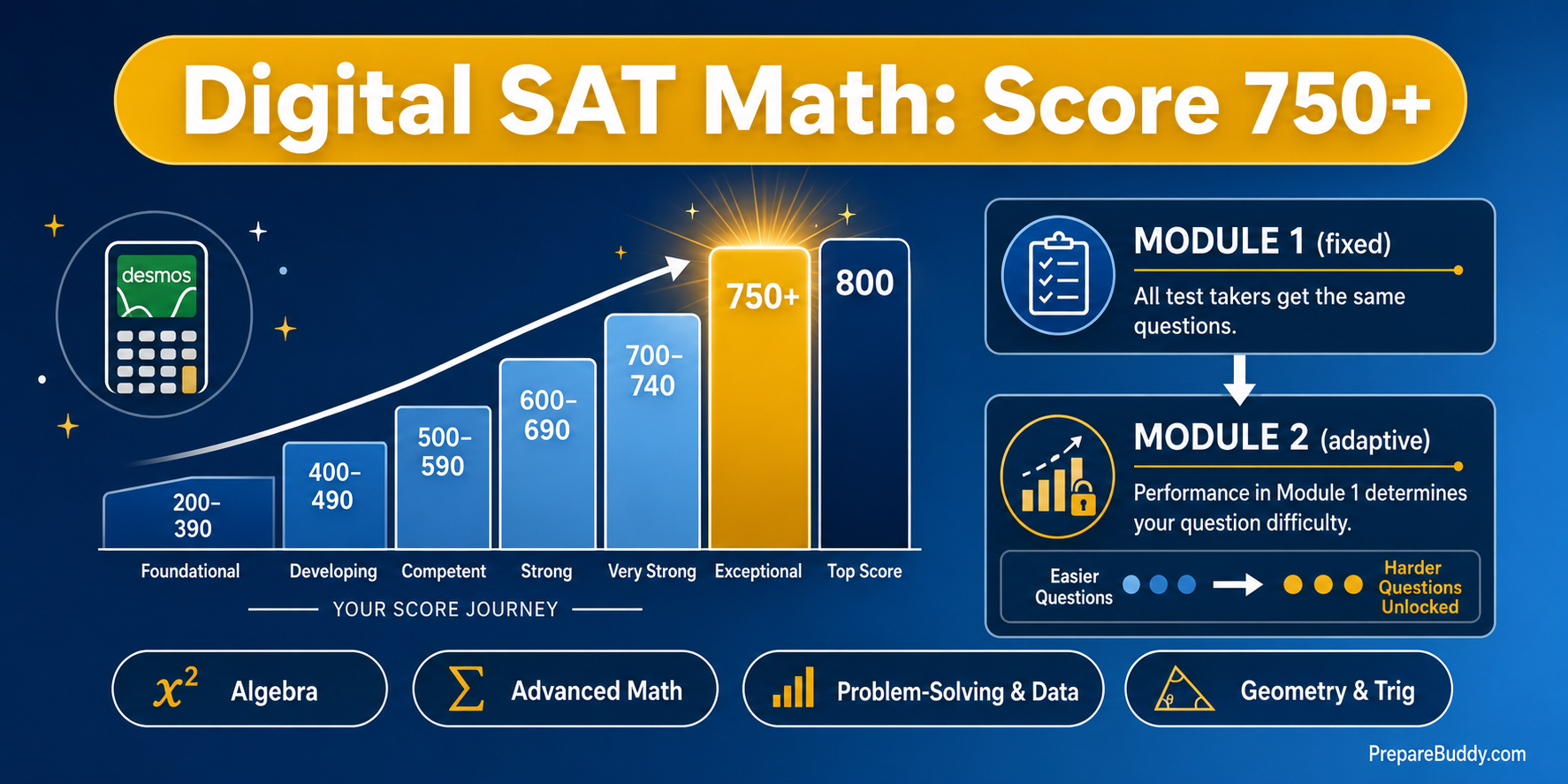
Here is the part of the Digital SAT Math section almost no one tells you about: your second module is not the same test for everyone. How you perform on the first 22 math questions decides whether your second module is built from easier questions (with a lower scoring ceiling) or harder ones (that unlock the full 800). Two students can answer the same number of questions correctly and walk away with very different scores. If you want to break 750 on Digital SAT Math in 2026, you have to play the adaptive engine, not just the math.
This guide breaks down exactly how the section is structured, where the points actually hide, and a six-step strategy to push your score into the top band.
How the Digital SAT Math Section Works in 2026
The Digital SAT is taken on-screen in the College Board's Bluebook app and uses a multistage adaptive design. The Math section is split into two modules. Module 1 is fixed in difficulty; Module 2 adapts based on how you did in Module 1.
| Feature | Digital SAT Math (2026) |
|---|---|
| Modules | 2 (Module 1 + adaptive Module 2) |
| Questions per module | 22 (2 are unscored experimental) |
| Total questions | 44 (38 scored) |
| Time per module | 35 minutes |
| Total time | 70 minutes |
| Question types | ~75% multiple choice, ~25% student-produced response (grid-in) |
| Calculator | Built-in Desmos graphing calculator on every question |
| Score range | 200–800 (Math); 400–1600 (total SAT) |
Two details change how you should prepare. First, harder questions carry more scoring weight, so a strong Module 1 routes you into a higher-value Module 2. Second, the Desmos calculator is now available for every question, including the ones that used to be "no calculator." Speed and tool fluency matter more than ever.
The Four Math Content Domains (and Where the Points Hide)
The College Board organizes Digital SAT Math into four content domains. Algebra and Advanced Math together make up roughly 70% of the section, so that is where a 750+ score is won or lost.
| Domain | Approx. share | What it covers |
|---|---|---|
| Algebra | ~35% | Linear equations, inequalities, systems, linear functions |
| Advanced Math | ~35% | Quadratics, exponentials, polynomials, nonlinear functions |
| Problem-Solving & Data Analysis | ~15% | Ratios, percentages, probability, data interpretation |
| Geometry & Trigonometry | ~15% | Area, volume, angles, right triangles, basic trig |
If your practice time is limited, weight it toward Algebra and Advanced Math first. Those two domains decide whether you reach the high-difficulty Module 2 in the first place.
How to Score 750+ on Digital SAT Math: A 6-Step Strategy
1. Lock down Module 1 like your score depends on it — because it does
Module 1 is the gatekeeper. Treat its 22 questions as the most important on the test. Aim to finish with five minutes to spare and use that time to recheck flagged questions. A clean Module 1 routes you into the harder, higher-ceiling Module 2.
2. Build domain fluency, not just "math review"
Generic review wastes time. Diagnose which of the four domains is costing you points, then drill that domain until it is automatic. A focused, AI-generated study plan that rebalances as your accuracy changes beats a static textbook every time.
3. Master the Desmos calculator
Because Desmos is available on every question, top scorers use it to solve algebraically heavy problems graphically — finding intersections, zeros, and vertex values in seconds. Practice typing systems of equations into Desmos and reading the graph. This single skill can save 8–10 minutes across the section.
4. Get strategic with grid-in (student-produced response) questions
Roughly a quarter of the section has no answer choices to reverse-engineer. There is no penalty for wrong answers, so never leave one blank. Know the entry rules cold: how to enter fractions, decimals, and negative values without losing points to formatting.
5. Train under real timing
35 minutes per module averages to about 95 seconds per question. You cannot build that pacing from untimed practice. Take full, timed, adaptive mocks so your brain learns to triage — answer the fast ones first, flag the slow ones, and return.
6. Review every mistake with a "why," not just a "what"
A score of 750+ comes from closing recurring error patterns: a misread domain restriction, a sign error, a misapplied formula. Tag each missed question by domain and error type so you can see the pattern — and use 24/7 AI tutor support to get an instant explanation the moment you are stuck, instead of waiting for the next class.
Why Adaptive Practice Beats Static Question Banks
The real exam adjusts to you, so your practice should too. Practicing on a fixed difficulty bank trains you for a test that no longer exists. PrepareBuddy's adaptive testing mirrors the Digital SAT's multistage design — your Module 2 gets harder or easier based on Module 1 performance, exactly like test day, so there are no surprises.
Accuracy of feedback matters just as much. PrepareBuddy generates SAT math content with a 120B-parameter model and verifies every answer with a dedicated math-reasoning model and a two-pass re-solve step that catches answer-key mismatches before a question ever reaches you. The result is practice questions that behave like the real thing, scored with 95% AI accuracy. Your analytics dashboard then shows exactly which domain is dragging your score, so every study session targets the highest-impact weakness.
A Realistic 4-Week Plan to 750+
| Week | Focus | Goal |
|---|---|---|
| 1 | Diagnostic + Algebra fundamentals | Identify weakest domain; rebuild linear/systems accuracy |
| 2 | Advanced Math + Desmos drills | Quadratics, exponentials; calculator-graphing fluency |
| 3 | Data Analysis + Geometry/Trig | Close the remaining ~30% of the section |
| 4 | Full timed adaptive mocks | Pacing, Module 1 consistency, error-pattern cleanup |
Start Practicing the Smart Way
Hitting 750+ on Digital SAT Math is less about doing more problems and more about practicing the way the real, adaptive test works — with accurate questions, instant feedback, and analytics that point you at your weakest domain. Start free for your first month (no credit card required), or schedule a demo to see how PrepareBuddy's adaptive SAT prep works. Coaching centers and consultants can view pricing for the full white-label platform.


Join the Discussion