

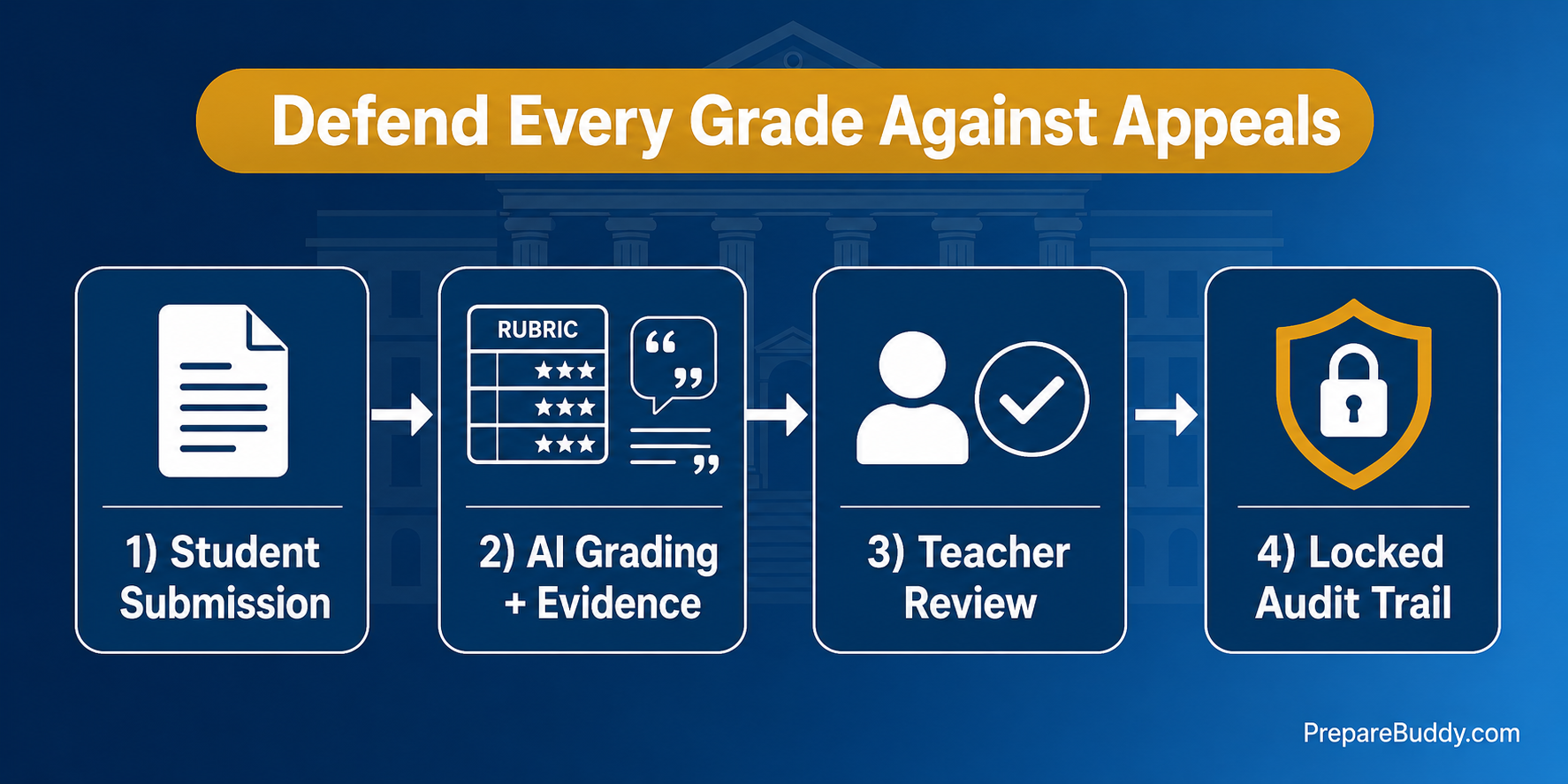
One unanswered grade appeal can stall a department for weeks. The instructor digs through old files, the registrar requests the rubric, the student escalates to the dean, and nobody can reconstruct exactly how the original mark was reached. Multiply that by a 500-student cohort and several disputed grades a semester, and the cost is not just hours of faculty time — it is accreditation risk and legal exposure. The institutions that handle university grade appeals calmly in 2026 have one thing in common: every grade they award is reproducible, evidence-backed, and stored with a complete audit trail.
This is exactly the problem AI-powered assessment was built to solve. Below is how universities are using AI audit trails, reference versioning, and evidence-based grading to defend every grade — and why it changes the economics of large-scale assessment.
Why grade appeals are getting harder in 2026
Three pressures have collided. Class sizes keep growing, so a single assessment may pass through 20 or more instructors with subtly different standards. Students are more willing to formally contest marks. And accreditation bodies increasingly expect documented, consistent grading processes rather than instructor judgment alone. When an appeal lands, the burden of proof sits with the institution — and "the instructor felt it was a credit" is not a defensible answer.
The traditional fix — moderation meetings, second-marking, spreadsheet trails — does not scale. It slows feedback, burns faculty time, and still leaves gaps when a dispute surfaces months after grades were released. PrepareBuddy approaches the problem differently: it makes defensibility a built-in property of every evaluation, not a manual reconstruction after the fact.
The real cost of an undefendable grade
Before looking at the solution, it helps to name what an institution actually loses each time a grade cannot be cleanly justified.
| Pain point | Impact on the institution |
|---|---|
| Inconsistent grading across 20+ instructors | Grade disputes, student complaints, accreditation concerns |
| No record of how a grade was reached | Manual re-grading, legal exposure, faculty time lost to appeals |
| 15–20 minutes per submission to mark | Faculty burnout, delayed feedback, missed deadlines |
| "AI grading is generic" perception | Faculty resistance and low adoption of any automated system |
The common thread is reproducibility. If you cannot show how a mark was produced, you cannot defend it — and you cannot prove your standards are consistent.
How AI audit trails defend every grade
PrepareBuddy's AI assessment engine is designed so that every evaluation produces a defensible record by default. Three mechanisms work together.
1. Evidence-based citations, not vague feedback
"You need to improve" is useless in an appeal. PrepareBuddy ties every score to specific evidence: direct quotes from the submission, an explanation mapped to a named rubric criterion, and references to similar high-quality examples. When a student contests a mark, the institution can point to the exact passage and the exact standard it was measured against.
2. RAG-enhanced grounding in your own standards
Rather than applying one-size-fits-all criteria, the platform uses retrieval-augmented generation (RAG) to find semantically similar, previously graded exemplars from your reference library before scoring anything new. The AI effectively sees "here is how we graded comparable work at a high-distinction level" first. This is what produces feedback that sounds like it came from your best graders — and it is why PrepareBuddy reports up to 94% alignment with human grader standards, a level a single generic model does not reach.
3. Reference snapshot versioning
This is the feature that wins appeals. Every batch evaluation stores a complete snapshot: the exact references used, the rubric state at that moment, and the model configuration. Months later, you can reproduce any evaluation exactly as it occurred. A multi-model verification pass adds a second independent check, and any large discrepancy between passes is flagged for human review before grades are released. Combined with full audit logging, FERPA-aligned data handling, and role-based access, this turns a grade dispute from a scramble into a lookup.
Manual grading vs. AI audit-trail grading
The difference is clearest side by side.
| Capability | Traditional manual grading | PrepareBuddy AI assessment |
|---|---|---|
| Time per submission | 15–20 minutes | Seconds, with parallel batch processing |
| Consistency across instructors | Varies by grader | Grounded in shared reference library |
| Evidence for each score | Often informal or absent | Specific citations mapped to rubric |
| Reproduce a grade months later | Rarely possible | Reference snapshot versioning |
| Independent verification | Optional second-marking | Multi-model verification with discrepancy flags |
| Audit trail for appeals | Manual reconstruction | Logged automatically with every evaluation |
The headline outcome for institutions: up to 75% time saved on grading — roughly 18+ hours per week returned to faculty — while making every grade easier to defend, not harder.
Beyond appeals: consistency and faculty development
An audit trail does more than settle disputes. Because every evaluation is structured and logged, the platform surfaces patterns that were previously invisible. Analytics dashboards track feedback quality trends across instructors, highlight where feedback consistently lacks detail, and benchmark graders anonymously against peers. Faculty development stops being guesswork and becomes data-driven — and consistency improves at the source, which is the best way to reduce appeals in the first place.
For institutions running their own examinations, the same engine underpins custom exams and integrates with existing grading workflows, so the defensibility extends from coursework to formal assessment.
How to get started
Rolling this out does not require a year-long IT project. A typical path looks like this:
Start with a single department or course as a pilot. Build a reference library from a set of previously graded, exemplary submissions so the AI learns your standards. Configure your rubric — entered manually or imported from an existing document. Run the pilot batch, review the evidence-based results, and compare them against your human markers. Once faculty see that the feedback reflects their standards, expand department by department. PrepareBuddy supports rapid deployment, typically within 24–48 hours of configuration, and is already trusted by 200+ institutions grading work from 50,000+ students.
Frequently asked questions
How does an AI audit trail actually help in a grade appeal?
It lets you reproduce the original evaluation exactly — the rubric, the reference examples used, the model configuration, and the specific citations behind each score. Instead of reconstructing a months-old judgment from memory, the institution presents a complete, timestamped record.
Will faculty accept AI grading?
Adoption is highest when feedback reflects the institution's own standards. Because PrepareBuddy grounds every evaluation in your reference library and shows evidence for each score, faculty see output that aligns with departmental expectations rather than generic AI commentary.
Is student data handled securely?
Yes. The platform is built for academic use with FERPA-aligned data handling, encryption in transit and at rest, single sign-on support, role-based access, and complete audit logging of all actions.
Can it handle large end-of-semester batches?
Yes. Submissions are processed in parallel, so large cohorts are evaluated far faster than sequential marking, with real-time progress tracking and bulk delivery of results.
Defend every grade with confidence
Grade appeals will not disappear — but they stop being a crisis when every mark is reproducible and evidence-backed. If your institution is spending faculty time defending grades it cannot cleanly reconstruct, it is time to change the underlying process. Schedule a demo to see how PrepareBuddy's AI assessment engine builds a defensible audit trail into every evaluation, or get started free — first month free, no credit card required.


Join the Discussion