

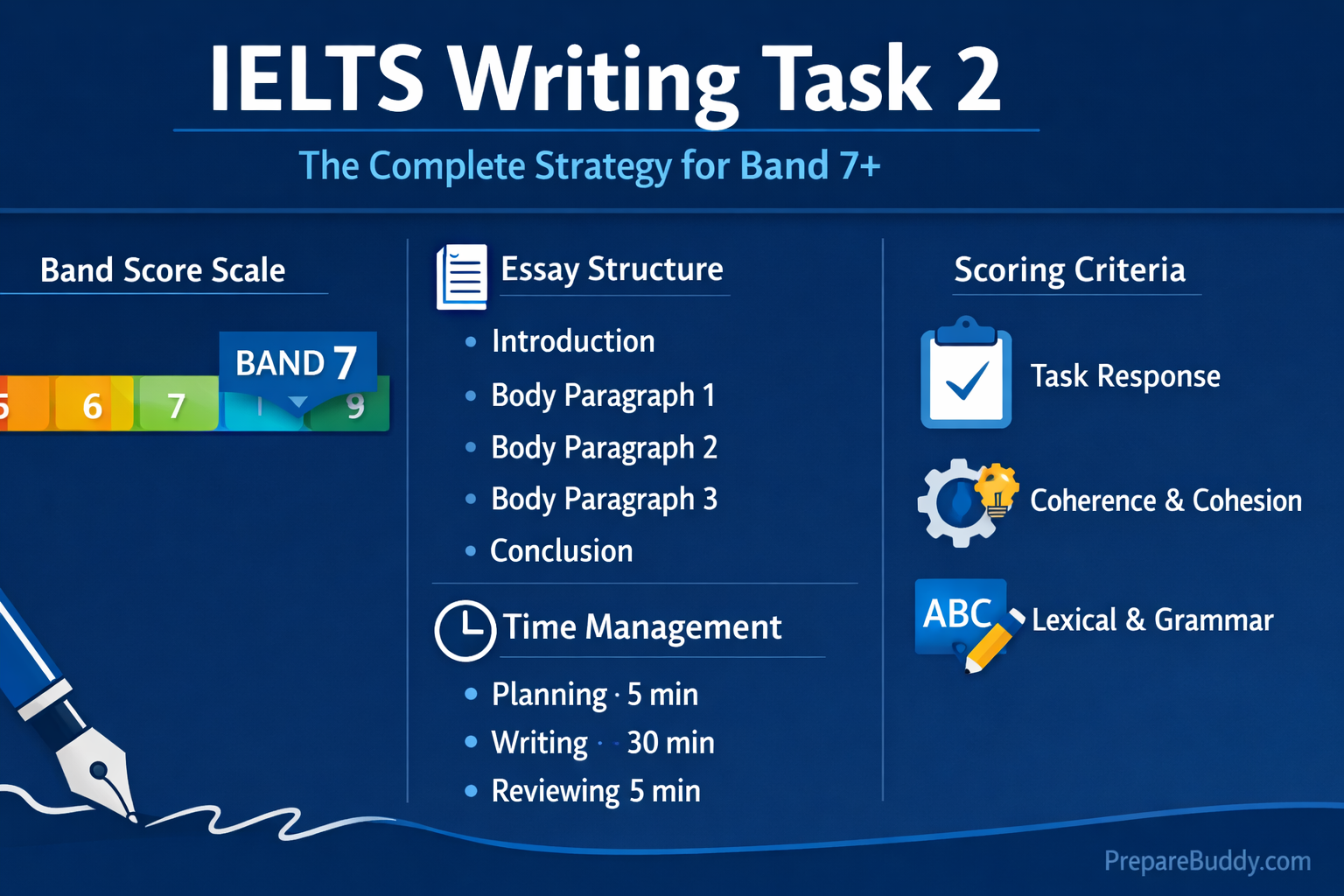
Band 7 in IELTS Writing Task 2 separates casual English speakers from university-ready communicators. With a minimum writing score of 6.5-7.0 required by most top universities in Australia, the UK, and Canada, this single 40-minute essay can determine whether you get your admission offer or face another test date. Here is a complete, actionable strategy to consistently hit Band 7 and above.
What IELTS Writing Task 2 Actually Tests
Before building your strategy, understand the four criteria examiners score you on — each weighted equally at 25%:
| Criterion | Band 7 Requirement | Common Mistakes That Drop Scores |
|---|---|---|
| Task Response (TR) | Clear position, fully developed ideas, relevant examples | Going off-topic, underdeveloped arguments, vague generalizations |
| Coherence & Cohesion (CC) | Logical paragraph structure, clear progression, effective linking | Over-using connectors (Furthermore, Moreover), no clear paragraph focus |
| Lexical Resource (LR) | Wide range of vocabulary, natural collocations, minor errors only | Memorized phrases, unnatural word choices, repetitive vocabulary |
| Grammatical Range & Accuracy (GRA) | Mix of simple and complex structures, frequent error-free sentences | Only simple sentences, or complex sentences with frequent errors |
The key insight: Band 7 does not require perfection. It requires consistent competence across all four criteria. Many test-takers score 8 in one area but 5 in another — the result is Band 6.5 overall.
The 5-Paragraph Structure That Works for Band 7+
Forget complicated essay templates. The most reliable structure for IELTS Writing Task 2 uses five clear paragraphs:
Paragraph 1 — Introduction (2-3 sentences): Paraphrase the question and state your position clearly. Do not waste words on background — examiners know the topic. Example: If the question asks whether governments should fund public transport, your thesis might be: “While private vehicle ownership offers convenience, government investment in public transport delivers greater economic and environmental returns for the population as a whole.”
Paragraph 2 — First Main Argument (5-7 sentences): One clear topic sentence, followed by explanation, example, and result. Use the PEEL method — Point, Explain, Example, Link back.
Paragraph 3 — Second Main Argument (5-7 sentences): Same structure, different argument. This paragraph should build on Paragraph 2, not repeat it.
Paragraph 4 — Counterargument or Additional Point (3-5 sentences): For opinion essays, briefly acknowledge the opposing view and explain why your position is stronger. For discussion essays, present the other side fairly.
Paragraph 5 — Conclusion (2-3 sentences): Restate your position using different words. Add a final thought or recommendation. Never introduce new ideas here.
Time Management: The 40-Minute Blueprint
Poor time management kills more Band 7 attempts than weak English. Here is the exact time split that works:
| Phase | Time | What to Do |
|---|---|---|
| Planning | 5 minutes | Read question twice, identify essay type, brainstorm 2-3 main ideas, outline paragraphs |
| Introduction | 5 minutes | Write 2-3 sentences: paraphrase + thesis |
| Body Paragraphs | 22 minutes | Write 3 body paragraphs (~7-8 minutes each) |
| Conclusion | 3 minutes | Summarize position in 2-3 sentences |
| Review | 5 minutes | Check grammar, spelling, word count (minimum 250 words) |
The planning phase is non-negotiable. Students who skip planning and start writing immediately almost always produce disorganized essays that cap out at Band 6.
IELTS Writing Task 2 Question Types and How to Handle Each
There are five main question types, and each requires a slightly different approach:
1. Opinion (Agree/Disagree): “To what extent do you agree or disagree?” — Take a clear side. You can partially agree, but your position must be consistent throughout. Band 7+ essays commit to a viewpoint.
2. Discussion + Opinion: “Discuss both views and give your opinion.” — Devote one paragraph to each view, then state your preference in a third paragraph or conclusion.
3. Advantages and Disadvantages: “What are the advantages and disadvantages?” — If asked for your opinion too, make sure to include it. Balance both sides but make your position clear.
4. Problem and Solution: “What problems does this cause? What solutions can you suggest?” — Identify 2-3 specific problems and match each with a realistic solution.
5. Two-Part Questions: “Why is this happening? Is this a positive or negative development?” — Answer both parts equally. Many students focus on one and lose marks on Task Response.
Vocabulary Strategies That Examiners Actually Reward
Band 7 requires demonstrating a “sufficient range of vocabulary to allow some flexibility and precision.” Here is what that looks like in practice:
Use topic-specific vocabulary naturally. For an essay about education: “pedagogical approaches,” “curriculum design,” “academic outcomes,” “student-centered learning.” For an environment essay: “carbon footprint,” “renewable infrastructure,” “ecological sustainability.”
Replace common words with precise alternatives. Instead of “good” — use “beneficial,” “advantageous,” “constructive.” Instead of “bad” — use “detrimental,” “counterproductive,” “adverse.” Instead of “important” — use “crucial,” “pivotal,” “fundamental.”
Use collocations, not isolated words. Examiners reward natural word partnerships: “pose a threat” (not “make a threat”), “draw a conclusion” (not “make a conclusion”), “address an issue” (not “solve an issue”).
Grammar Structures That Push You to Band 7
You need a mix of simple and complex sentences. Here are the structures that demonstrate Band 7 grammatical range:
Conditional sentences: “If governments invested more in renewable energy, carbon emissions would decrease significantly within a decade.”
Relative clauses: “Students who receive personalized feedback, which targets their specific weaknesses, show faster improvement than those using generic study materials.”
Passive constructions: “It could be argued that traditional methods are being replaced too quickly” — useful for academic register.
Concessive clauses: “Although technology offers convenience, it can also create dependency that undermines critical thinking skills.”
The key is accuracy over complexity. One error-free complex sentence per paragraph is better than three complex sentences with errors.
How AI Writing Analysis Accelerates Your Improvement
The biggest challenge in IELTS writing preparation is getting quality feedback. Human tutors are expensive and often unavailable for daily practice. This is where AI-powered writing analysis changes the game.
PrepareBuddy's AI writing analysis evaluates your essays across all four IELTS band descriptors — Task Response, Coherence, Lexical Resource, and Grammar — with 95% scoring accuracy verified against human examiners. The system provides specific, actionable feedback rather than generic comments, highlighting exactly which sentences need restructuring, which vocabulary choices are unnatural, and where your argument logic breaks down.
Students using AI-scored practice tests report faster improvement because they can write multiple essays per day and get instant feedback, compared to waiting days for a human tutor to review one essay. The platform supports unlimited IELTS practice across all four modules, so you can combine writing practice with reading, listening, and speaking preparation in a single study session.
Band 7 Checklist: Review Before Every Practice Essay
| Checkpoint | Band 7 Standard | Self-Check Question |
|---|---|---|
| Word Count | 250+ words (aim for 270-300) | Did I write enough without padding? |
| Position | Clear throughout | Can someone read my intro and know my stance? |
| Paragraphing | 4-5 clear paragraphs | Does each paragraph have ONE main idea? |
| Examples | Specific, relevant | Are my examples concrete or just vague claims? |
| Vocabulary | Varied, topic-appropriate | Did I repeat any key word more than twice? |
| Grammar Mix | Simple + complex | Do I have at least 2 complex structures per paragraph? |
| Cohesion | Natural flow | Would it read well without transition words? |
| Conclusion | Restates position | Did I summarize without introducing new ideas? |
Start Practicing with Instant AI Feedback
Consistent practice with quality feedback is the fastest path to Band 7 in IELTS Writing Task 2. Take a free IELTS practice test to benchmark your current writing level, then use AI-powered scoring to track your improvement across every practice essay. With the right strategy and daily practice, Band 7 is achievable within 2-4 weeks of focused preparation.


Join the Discussion