

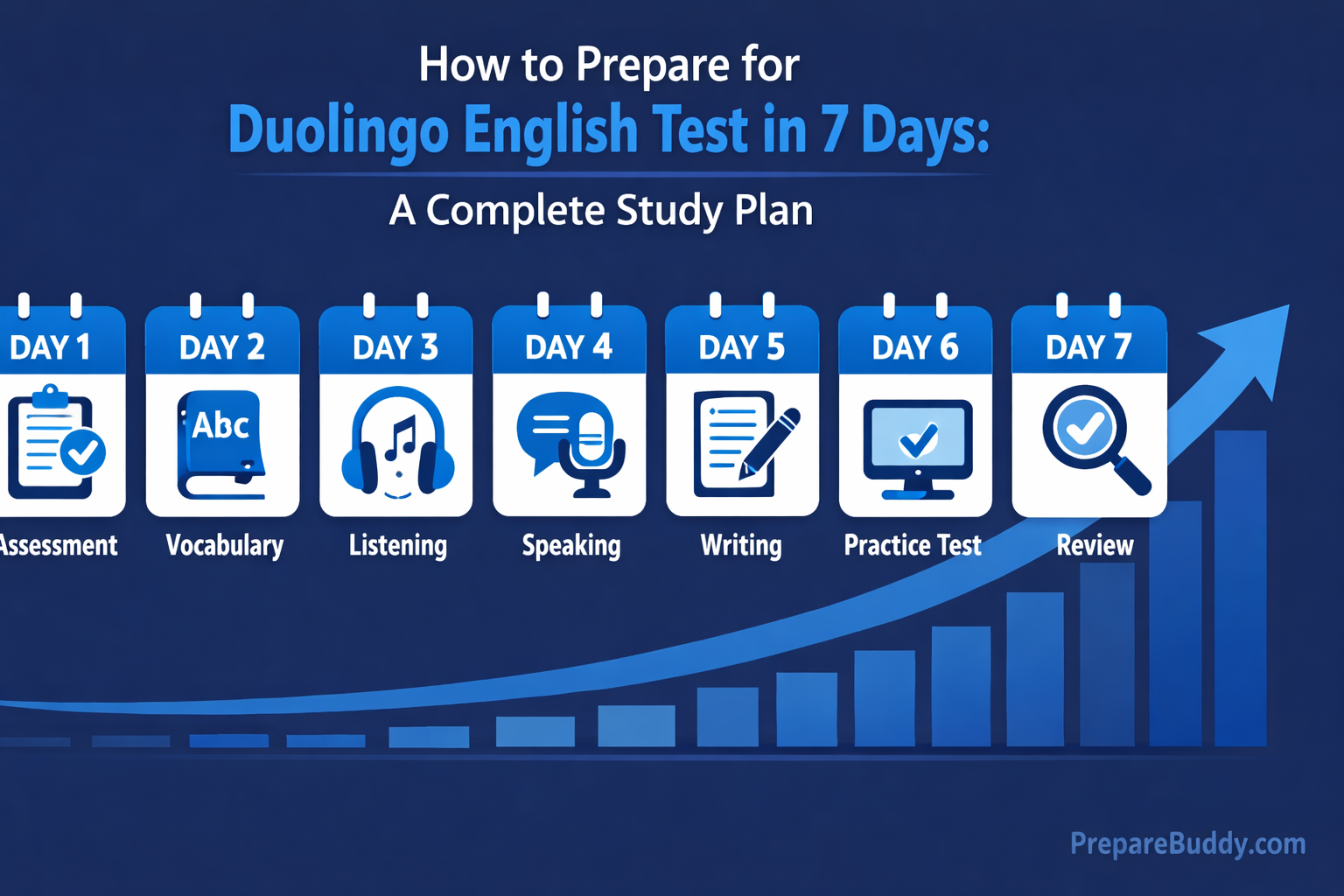
You just booked your Duolingo English Test — and it's in 7 days. Before the panic sets in, here's what you should know: the DET is one of the most strategically crammable English proficiency tests available. At 60 minutes with no scheduling delays, it rewards focused preparation over months of passive study. Over 50,000 students have used structured practice plans to hit their target scores, and this guide breaks down exactly what to do each day.
Understanding the Duolingo English Test Format
Before diving into your 7-day plan, you need to understand what you're preparing for. The DET isn't structured like IELTS or TOEFL — it uses a computer-adaptive format that adjusts question difficulty based on your answers in real time.
| DET Component | What It Measures | Score Range | Question Types |
|---|---|---|---|
| Literacy | Reading + Writing | 10–160 | Fill in blanks, read passages, interactive reading |
| Comprehension | Reading + Listening | 10–160 | Listen and respond, read and complete |
| Conversation | Listening + Speaking | 10–160 | Listen and speak, speaking sample |
| Production | Writing + Speaking | 10–160 | Write about topic, speaking sample |
Your overall score (10–160) is a weighted combination of these four subscores. Most universities require between 100–130, with top programs asking for 120+.
Day 1: Baseline Assessment and Gap Analysis
Time commitment: 2–3 hours
Start by taking a full-length practice test to establish your baseline. This isn't about scoring well — it's about identifying exactly where your gaps are. Take the free practice test on PrepareBuddy to get an AI-scored breakdown across all four subscores.
After your practice test, analyze your results: if Literacy is your weakest area, you need more reading and vocabulary work. If Conversation scores are low, speaking fluency and listening comprehension need priority. If Production lags behind, focus on writing coherence and speaking confidence. Record your baseline scores — you'll compare these at the end of your 7 days.
Day 2: Vocabulary and Literacy Power-Up
Time commitment: 2–3 hours
Literacy questions on the DET test your ability to recognize real English words, complete sentences, and read passages quickly. Here's your focused approach:
Morning session (1.5 hours): Practice C-Test format questions — fill in missing letters in words. This is a signature DET question type that rewards strong vocabulary instincts. Work through at least 30 practice items, paying attention to common suffixes (-tion, -ment, -ness, -able) and prefixes (un-, re-, dis-, pre-).
Afternoon session (1 hour): Read 3–4 articles from sources like BBC, The Economist, or academic journals. For each article, note 10 new vocabulary words and use them in sentences. The DET doesn't test obscure vocabulary — it rewards functional academic English.
Day 3: Listening and Comprehension Training
Time commitment: 2–3 hours
Comprehension questions combine listening and reading, often requiring you to type what you hear or answer questions about audio passages.
Active listening practice: Listen to 3–4 TED talks or academic podcasts. After each, write a 50-word summary from memory. This builds the exact skill the DET tests — processing spoken English and reproducing key ideas.
Dictation drills: Play 10-second audio clips and type exactly what you hear. Start slow and increase speed. The DET's dictation-style tasks require precise listening, and PrepareBuddy's AI-powered practice generates unlimited dictation exercises with instant scoring.
Day 4: Speaking Confidence Builder
Time commitment: 2–3 hours
The DET speaking tasks require you to respond to prompts in 30–90 seconds. Unlike IELTS, there's no human interviewer — just you and the microphone. This is actually an advantage for nervous test-takers.
Structured speaking practice: Use the PREP framework for every speaking response — Point (state your main idea), Reason (explain why), Example (give a specific example), Point (restate your position). This ensures your answers have clear structure even under time pressure.
Voice AI practice: PrepareBuddy's Voice AI technology provides real-time pronunciation scoring, fluency analysis, and feedback across 30+ English accents. Practice at least 10 speaking prompts, focusing on clarity over speed. The AI analyzes 48 emotion markers to help you sound natural and confident.
Day 5: Writing Under Pressure
Time commitment: 2–3 hours
DET writing tasks ask you to write about a topic in 3–5 minutes. That's tight, and most students lose points by either writing too little or rambling without structure.
The 5-minute writing formula: Minute 1 — plan and outline your 3 key points. Minutes 2–4 — write one paragraph per point, aiming for 50+ words each. Minute 5 — review grammar and spelling. Target 100–150 words per response for a strong Production subscore.
Practice with AI feedback: PrepareBuddy's AI Writing Analysis evaluates your responses using the same criteria as DET scoring — task completion, vocabulary range, grammatical accuracy, and coherence. Submit at least 5 writing samples and study the feedback patterns.
Day 6: Full Practice Test and Strategy Refinement
Time commitment: 3 hours
Take another full-length practice test under exam conditions. Find a quiet room, use only one screen, no notes, and complete the full 60 minutes without breaks.
| Subscore | Day 1 Baseline | Day 6 Progress | Realistic 7-Day Gain |
|---|---|---|---|
| Literacy | Your baseline | Your progress | +10–15 points |
| Comprehension | Your baseline | Your progress | +10–15 points |
| Conversation | Your baseline | Your progress | +5–10 points |
| Production | Your baseline | Your progress | +5–10 points |
After the test, review every question you struggled with. Identify the 2–3 question types where you lost the most points — these are your targets for Day 7.
Day 7: Final Review and Test-Day Preparation
Time commitment: 2 hours + logistics
Morning — targeted weak spots: Spend 1.5 hours drilling only the question types you identified on Day 6. Don't try to cover everything — depth beats breadth at this stage.
Afternoon — logistics check: The DET is taken at home, so your testing environment matters. Verify your setup: a working camera and microphone, stable internet (at least 2 Mbps), a supported browser (Chrome recommended), a valid government-issued ID, and a quiet, well-lit room with no one else present.
Evening — rest. Your brain consolidates learning during sleep. No cramming the night before. Review your vocabulary list for 20 minutes, then stop.
DET Score Equivalency: What Your Score Means
Universities accept the DET as an alternative to IELTS and TOEFL. Here's how scores generally map:
| DET Score | IELTS Equivalent | TOEFL iBT Equivalent | Typical Requirement |
|---|---|---|---|
| 160 | 8.5–9.0 | 118–120 | Top programs, scholarships |
| 130–155 | 7.0–8.0 | 100–117 | Most competitive universities |
| 105–125 | 6.0–6.5 | 80–99 | Standard admission |
| 85–100 | 5.5 | 60–79 | Foundation or pathway programs |
Why Structured Practice Beats Random Study
The difference between students who improve 20+ points in a week and those who plateau comes down to structured, adaptive practice. Random YouTube videos and scattered study sessions don't target your specific weak points.
PrepareBuddy's Duolingo English Test preparation platform offers unlimited AI-generated practice tests matching the current DET format, with AI-powered scoring providing the same subscore breakdown you'll see on test day. Combined with personalized AI study plans that adapt based on your performance, you get preparation that targets exactly where you need improvement.
Ready to Start Your 7-Day DET Journey?
Every day counts when you're preparing for the Duolingo English Test. Start with a free practice test to establish your baseline, then follow this plan to maximize your score.


Join the Discussion