

Most universities have invested heavily in a learning management system — Canvas, Moodle, Blackboard, D2L, or Schoology — and most of them are still grading long-form submissions by hand inside it. A 400-student essay assignment means 100 hours of teaching assistant time spent on rubric compliance, and a fresh round of grade appeals every semester from students who got different scores from different markers.
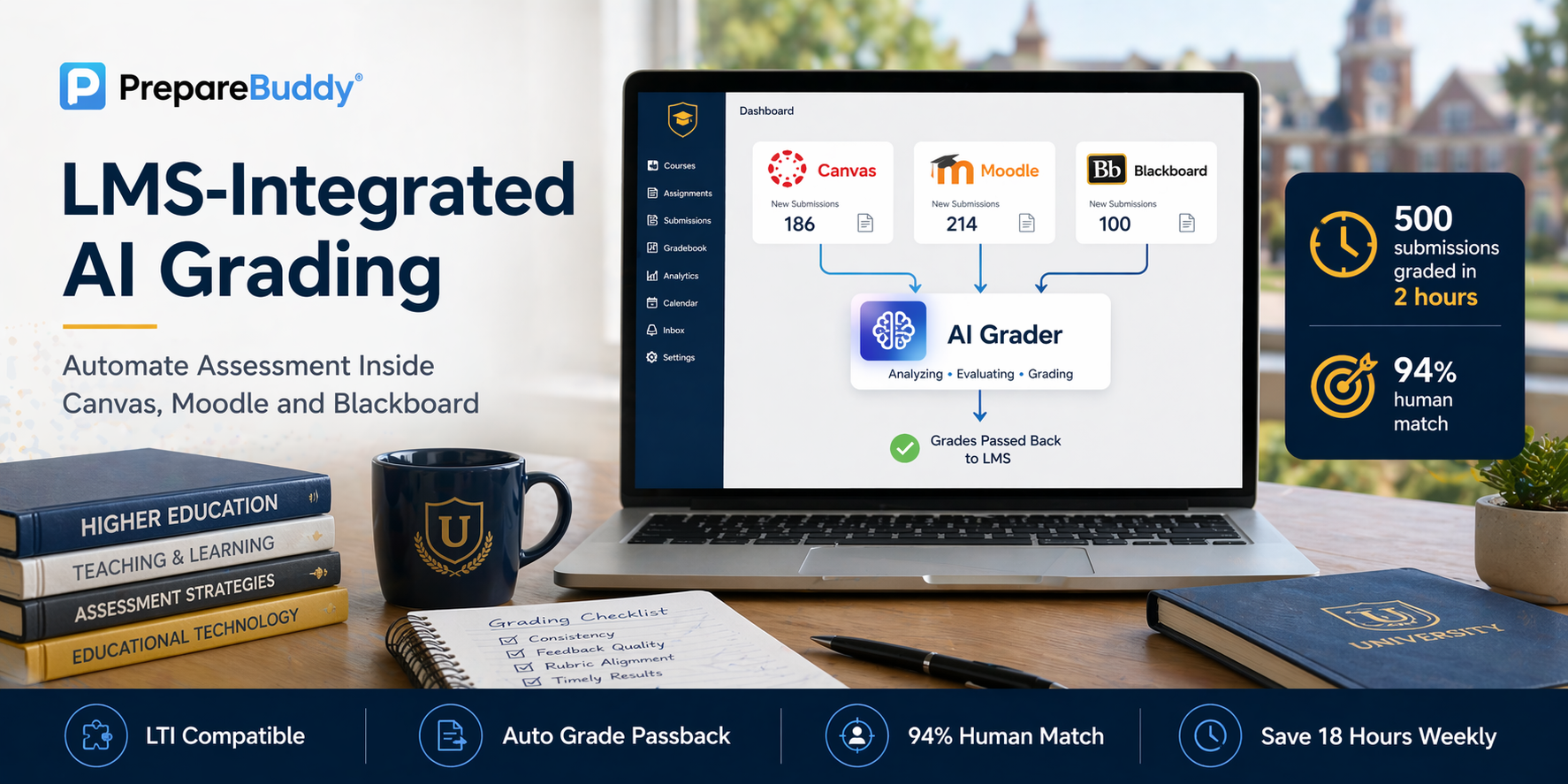
The gap between "we have an LMS" and "our LMS grades consistently at scale" is exactly where LMS-integrated AI grading is reshaping institutional assessment in 2026. Instead of adding yet another tool that sits outside the LMS, this approach plugs straight into Canvas, Moodle, and Blackboard via LTI grade passback — so submissions flow in, AI evaluates them with institutional reference examples, and grades flow back automatically.
Why LMS-Integrated AI Grading Matters More Than Standalone Tools
Plenty of AI grading tools exist. The reason most universities never scale them is simple: they require teachers to leave the LMS, upload submissions elsewhere, review results in a second interface, and manually push grades back into the gradebook. That workflow adds friction — and in a busy term, friction is what kills adoption.
LMS-integrated AI grading removes every one of those steps. Assignments stay inside Canvas or Moodle, students submit as they normally would, and AI evaluation runs in the background. The grade, the evidence trail, and the feedback comments return to the LMS gradebook with no manual copy-paste. For a department grading thousands of submissions a term, that's the difference between a tool that's used and one that's abandoned.
Which LMS Platforms Are Covered
On PrepareBuddy's AI Assessment engine, native integration is in place for the five LMS platforms that dominate higher education globally. Here's what each supports:
| LMS | Grade Passback | Assignment Link | Single Sign-On |
|---|---|---|---|
| Canvas | Yes (with auto-retry) | Yes | Yes |
| Moodle | Yes (with auto-retry) | Yes | Yes |
| Blackboard | Yes (with auto-retry) | Yes | Yes |
| D2L Brightspace | Yes | Yes | Yes |
| Schoology | Yes | Yes | Yes |
The auto-retry behaviour matters more than it sounds. LMS APIs go down, networks drop, and grade passback calls fail in the middle of large batches. Auto-retry means the system keeps pushing grades until the LMS acknowledges receipt — nobody has to babysit the queue.
What a Real LMS-Integrated Grading Run Looks Like
Here's the workflow an instructor experiences on a typical 500-student essay assignment when AI grading is wired into the LMS:
- Assignment created in the LMS as usual. The AI grading tool appears as an LTI-linked option on the assignment setup page.
- Students submit in the LMS. No change to the student experience — they upload PDFs, DOCX, or TXT files as they normally would.
- Batch evaluation runs. The AI retrieves 5 similar graded references from the institution's reference library, evaluates each submission, and generates grade + evidence citations + improvement notes.
- Grades flow back via LTI passback. Scores appear in the LMS gradebook automatically. Feedback attaches to the submission as downloadable PDF or DOCX.
- Instructor spot-checks flagged items. Anything the AI flagged for human review (grade disagreements across verification passes) surfaces in a review queue.
Manual vs. LMS-Integrated AI Grading at Scale
| Class Size | Manual Grading Time | LMS-Integrated AI | Time Saved |
|---|---|---|---|
| 50 students | 12.5 hours | ~15 minutes | 98% |
| 200 students | 50 hours | ~45 minutes | 98.5% |
| 500 students | 125 hours | ~2 hours | 98.4% |
Across institutions using the platform, the aggregate outcome is 75% time saved on grading and 18+ hours freed weekly per teacher — time that goes back into actual instruction, office hours, and curriculum development.
The Accuracy Question: How Good Is the AI's Grade?
LMS integration is only useful if the grades flowing back are ones teachers actually trust. This is where the underlying AI engine matters. The platform's RAG-enhanced evaluation retrieves similar high-quality examples from the institution's own reference library before grading — so the AI is calibrated to your rubric, not a generic one. Verification options scale to what's at stake:
| Verification Level | Use Case | Human Grader Alignment |
|---|---|---|
| Single Pass | Formative feedback, practice | 85% |
| Dual Verification | Standard coursework | 91% |
| Triple Verification | High-stakes exams, final grades | 94% |
For high-stakes assignments flowing through the LMS — final essays, capstone submissions, mock exam batches — triple verification runs independent evaluation passes and flags discrepancies for human review before the grade is written back to the gradebook. Nothing goes to the student until the workflow allows it.
Grade Appeals Become Easier, Not Harder
A common compliance concern: if AI grades flow straight into the LMS, how do you defend a grade six months later when a student appeals? The answer is reference snapshot versioning. Every batch evaluation stores exactly which reference examples were used, the rubric version, the model version, and the evidence citations. When an appeal comes in, the institution can reproduce the exact evaluation — same inputs, same snapshot, same result — and show the evidence trail.
This is stronger than manual grading, where a marker's reasoning usually lives only in their head. With LMS-integrated AI grading, every decision is documented, retrievable, and comparable to the reference library.
Who Benefits Most
LMS-integrated AI grading delivers the strongest return where class sizes are large and grading consistency is critical:
- Universities running large-enrolment undergraduate courses on Canvas, Moodle, or Blackboard. See the universities solution for deployment patterns used by institutional partners.
- Coaching centers using LMS platforms to deliver mock tests and writing evaluations — the coaching institutes solution covers how LMS-integrated AI grading scales across teachers and batches.
- Language institutes running band-score-driven mock tests inside their LMS, where students expect defensible scoring.
- Education consultants offering assessment-as-a-service on a white-label LMS deployment.
How to Evaluate This for Your Institution
The fastest test is a real pilot against one LMS course and one assignment batch. Export 50-100 previously graded submissions, load them as the reference library, then run a fresh batch through the LMS integration. Compare AI grades to teacher grades, inspect the evidence citations, and check that the grades write back cleanly into the gradebook.
Deployment typically takes 24 to 48 hours, including LMS integration setup, reference library ingestion, and rubric calibration. No engineering team on the university's side is required.
If you want to see how this would wire into your Canvas, Moodle, or Blackboard setup, schedule a walkthrough and we'll run a real batch against your own reference library before anything changes in your production environment.


Join the Discussion